

The Return
I have not published since The Bifurcation on March 30. Four months of silence, through the most violent macro tape in years. Let me tell you what that silence was.
It was not absence. It was the workshop.
When the market went into correction, there were no trades worth forcing. That is exactly when a process-driven investor should go quiet and go inward — not manufacture opinions the tape is not paying for. So I did the unglamorous work. I built the models to confirm the theses. I rebuilt the system that this newsletter runs on. I refined the frameworks. I managed the book through the drawdown.
The scientific method my father handed me — observe, hypothesize, test, refine — the refine step does not happen in public. It happens in the lab, in the drawdown, when nobody is paying you to be right. Most people blow up in corrections precisely because they cannot sit still. The discipline is knowing when there is nothing to do, and using that time to get better.
The market turned this week. The system is built. And every call it was designed to catch is printing at once.
This is the re-entry. Here is everything the tape told me while I was quiet — and why I am done letting the right calls go undocumented.
Look at the tape, not the headlines.
The Numbers
Start with the proof, because it is the entire point of this publication.

Look at the All Weather number. $270,050 in March. $270,325 today. Two hundred and seventy-five dollars apart after four months of the worst tape since 2022 — the S&P’s longest weekly losing streak in years, the 30-year yield at 5%, oil round-tripping from $112 to $79 to $100 and back. That portfolio held its value to within a rounding error. Not by luck. By design. It was built to survive the exact regime it was positioned for, and it did. The total account is actually up almost $9,000.
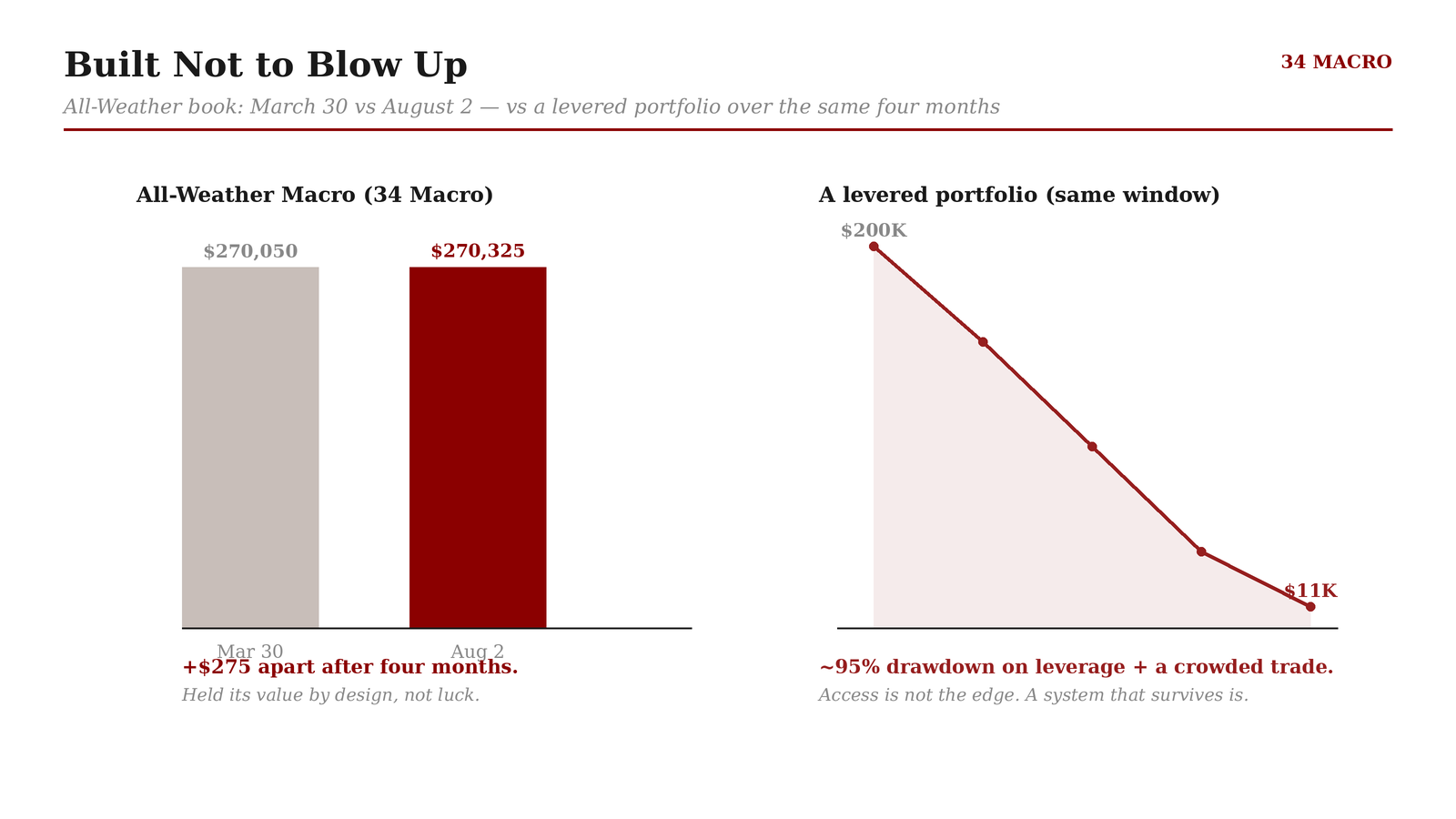
Capital preserved by design: the All-Weather book sits $275 from where it was four months ago, through the most violent macro tape in years. The total account ground higher.
Now the part that makes the point land. Over the same four months I have been quiet, I watched friends take a portfolio from roughly $200,000 to roughly $11,000. Same market. Same months. A ninety-five percent drawdown.
I am not telling you that to dunk on anyone. I am telling you because it is the whole thesis of 34 Macro, demonstrated in the cruelest possible way. The market was never built for people like us, and the way you win is not by gambling — it is by building a system that does not blow up. They had access and torched it on leverage and a crowded trade into a correction. That is how a $200,000 account becomes $11,000: not stupidity, but leverage plus conviction pointed the wrong way at the wrong moment, with no framework to tell you when to be out.
A macro portfolio is not built to print the biggest number in the melt-up. It is built so that when everyone else is forced to sell at the lows, you are still standing — capital intact, powder dry, conviction whole. That is what these numbers are. That is what the framework is protecting you from.
Playing the Field: The Warsh Misread
Here is the call the entire market has backwards.
Everyone has decided Kevin Warsh is a hawk who lost his credibility. He held rates in July on a 9-3 vote — three officials dissenting for a hike, the most dissents since 2016 — gave almost no forward guidance, and the commentary since has been a chorus of “he is not credible, he is behind the curve, the bond market does not believe him.”
I think they have it exactly backwards. I think Warsh is more dove than hawk, and the hawkishness is a costume he had to wear to earn the right to be who he actually is.
Think about the position. A new Fed Chair, walking in under a five-year inflation cloud, cannot open dovish — do that and the market owns you, and the “political puppet” narrative buries you before you chair a single meeting. So you front-load the hardness. You establish that you hold the line on inflation. You bank the credibility. And then the mask can come off. That is not weakness. That is sequencing.
And the sequencing is the tell. Look at what he is actually telling the market: play the field, not the Fed. Stop waiting for my signal. Use the data the market is handing you, run it through your own models, and decide for yourself whether the rate level is right. He has said it plainly. Read as “no credibility,” the absence of forward guidance is a failure. Read correctly, it is the entire point — he is forcing the market to price the economy off its own work instead of his dot plot. For a publication built on exactly that principle, this is not a bug. It is the mandate.
Now the July hold, which the market called indecision. It was the opposite. Into that meeting, the market had stuffed roughly seventy-five basis points of hikes into the back end of the SOFR curve by December. I read that as unrealizable — priced to be priced out, not delivered. He held. The hike path started bleeding. And then the very next morning, PCE printed cooler, especially month over month.
Sit with that. Imagine he had hiked Wednesday. Cooler inflation Thursday. A rate hike into a disinflation print — that is a live policy error, and that is when credibility actually dies. The hold was not indecision. It was him refusing to be jammed into the mistake the market was begging him to make. The people calling him not credible have it backwards: the hold was the credible move, and the data ratified it eighteen hours later.
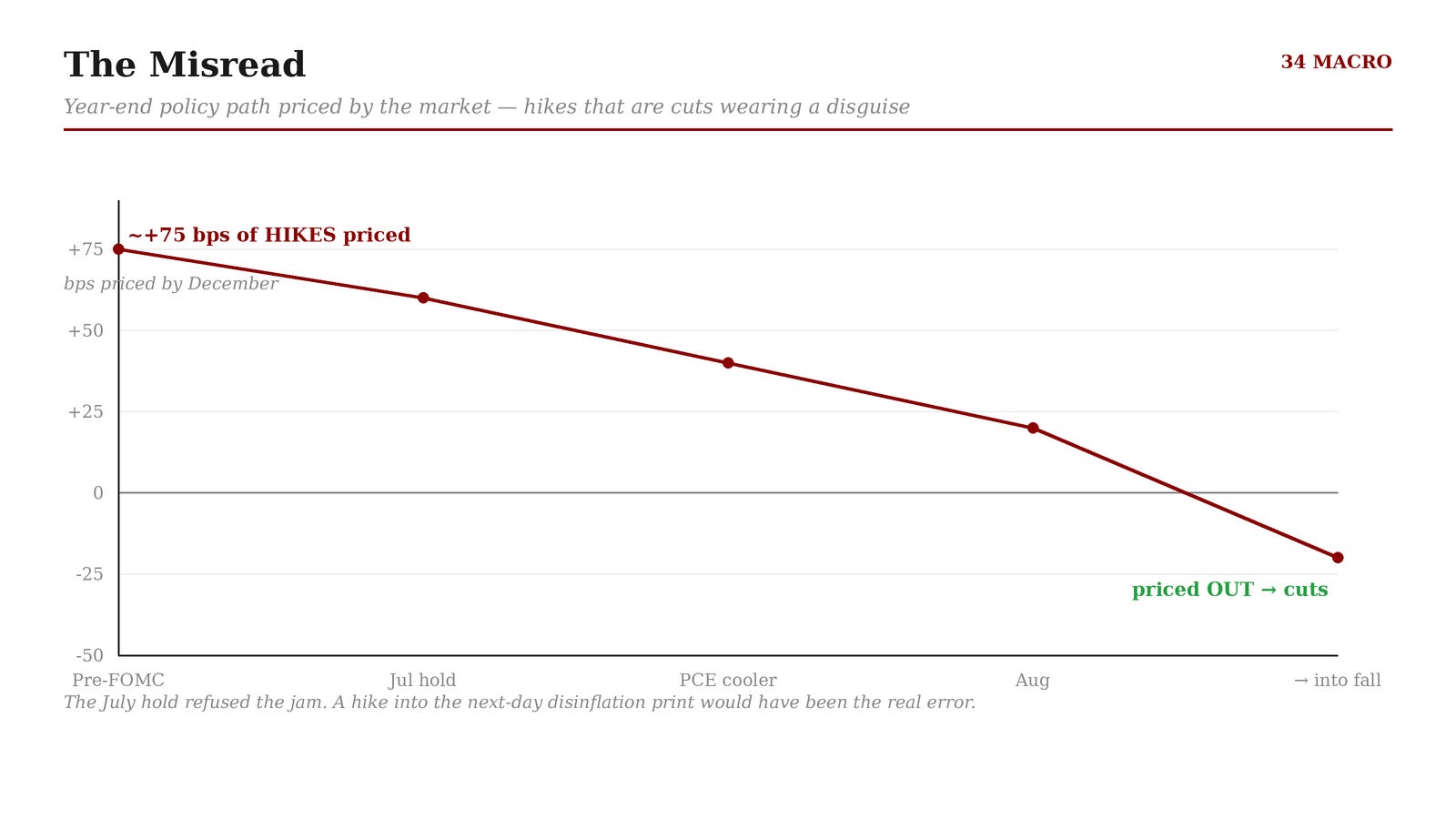
The misread: the market priced ~75bps of hikes into year-end, then the July hold and a cooler next-day PCE started pricing them out. Those “hikes” two-to-three quarters out are cuts wearing a disguise.
And the 30-year yield spiking to a nineteen-year high after the meeting? The market read it as the bond market screaming that the Fed lost control. That is backwards too. It is mechanical. A hold that takes near-term hikes off the table does two things to the long end: it prices more term premium — you demand more to hold duration when the front end is not moving — and it prices more growth, because the AI-capex economy is holding up. More term premium plus more growth expectation equals a higher 30-year yield. That is a bear steepener for the right reason — growth and term premium — not the panic reason. The same people misreading the no-guidance as “no credibility” are misreading the steepening as “no control.” Both are features. Both are being read as bugs.
There is one more thing, and I will say it plainly because it matters: Warsh and Trump are talking. Anyone who thinks otherwise is kidding themselves. And I do not think that is the scandal the market treats it as. If Warsh knows — through that line — that this inflation is a temporary energy bump that comes down as the negotiation lands, then he is making policy on better forward information than the market has. That is not doing Trump’s bidding. That is refusing to tighten into a print he already knows is about to roll over. The credibility knock is real and worth naming honestly. But the substance cuts the other way: better information produces better policy, and holding through a spike you know is transitory is the correct call, not a compromised one.
The Disinflation Is Already in the Pipeline
This is why not hiking was right, and why the hikes the market priced become cuts: the disinflation is coming from three independent directions, and Warsh can see all of them.
One — the energy bump fades. June PCE already stepped down: headline to 3.7% from 4.1%, core to 3.3% from 3.4%, driven by the energy pullback from the brief ceasefire. That is the supply shock unwinding. The same “temporary energy shock, do not chase it” logic I have run since January, now applied to the Fed’s reaction function.
Two — seasonality turns soft. The seasonal factors work in the Fed’s favor for the next couple of months. Softer prints are coming, mechanically, into the fall.
Three — the ruler itself is being recalibrated. This is the one almost nobody is pricing. The Bureau of Economic Analysis is changing how it calculates three components of PCE — portfolio management fees, computer software, and legal services — effective September 30, applied retroactively to 2021. Goldman Sachs and JPMorgan estimate the change shaves roughly one to two tenths off core PCE. Goldman’s model already moved its December core PCE forecast from 3.2% down to 3.0% on it. The largest distortion being fixed is poetic: portfolio management fees were tied too closely to the stock market, so when equities rip, those fees inflated the inflation number even though the service never changed. The old ruler was measuring wealth effects, not prices.
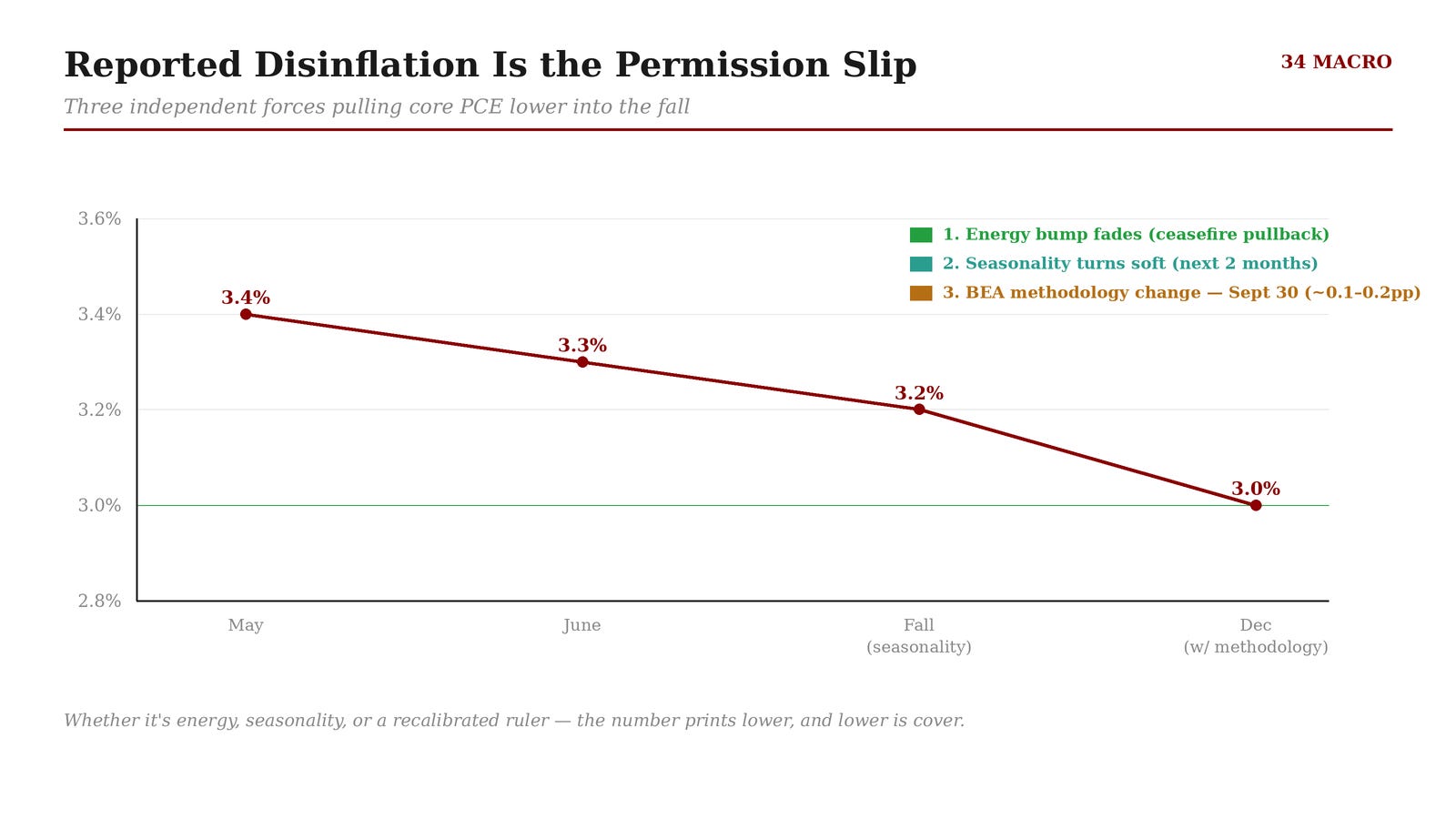
Three independent disinflation forces stacking onto the same fall reports: the energy bump fading, soft seasonality, and the Sept 30 BEA methodology change (~0.1–0.2pp off core; Dec core 3.2%→3.0% per Goldman).
The skeptics are already calling the methodology change fake disinflation — “prices did not move, only the ruler did.” Run it through the framework and that is the point. Warsh does not need real disinflation to hold and then cut. He needs reported PCE to come down so the print gives him cover. Energy fading, soft seasonality, a recalibrated ruler — the number prints lower into the fall, and a lower number is the permission slip. Calling it “just methodology” is the same mistake as calling the hold “no credibility.” A feature, read as a bug.
The path back to 2% is real, but it takes time. Which is exactly why hiking now — only to cut in two quarters — would have been the whipsaw. Holding preserves the optionality. He can see the disinflation coming from three directions and refuses to tighten into it.
And the hard data is already printing it. The most recent CPI report — June’s — came in cooler than expected across the board. Headline fell 0.4% on the month, the biggest one-month drop in more than six years, cutting the annual rate to 3.5% from 4.2%. Energy led it down, with gasoline off nearly ten percent in a single month. But the number that matters is the core — prices stripped of food and energy — which came in flat, the lowest reading outside a recession since 2017, pulling the annual core rate to 2.6%. That is the supply shock unwinding in real time, exactly as the framework said it would.
Now watch what Warsh did with it, because it is the whole thesis in one quote. Handed the softest inflation print in years, he did not take a victory lap. He said: “There might be some that look at this morning’s data and say, ‘Oh, mission accomplished, everything is swell.’ That is not my view.” Read that through the strategic-dove lens. A Chair who genuinely wanted to sound hawkish has no reason to downplay data — the market does that for him. A Chair banking credibility so he can cut later is precisely the one who refuses to celebrate soft prints, because declaring victory early is how you lose the room. He is not fighting the disinflation. He is pocketing it quietly while keeping the hard-money face on. The next print lands August 12 — and the pipeline says it keeps cooling.
The Lever: Trump, Oil, and the Timing
The Fed pivot and the energy negotiation are not two trades. They are the same trade.
Watch the mechanism, because it fired live this evening at the Futures Market Open. Sunday morning, Trump announced he called off a strike on Iran because “the parameters of a deal have been agreed to” — terms including reopening the Strait of Hormuz and ending the nuclear program — with negotiations resuming Monday. The moment Futures opened, oil cracked: WTI down more than seven percent, through $79, Brent down ten. Truth Social prints, oil dumps.


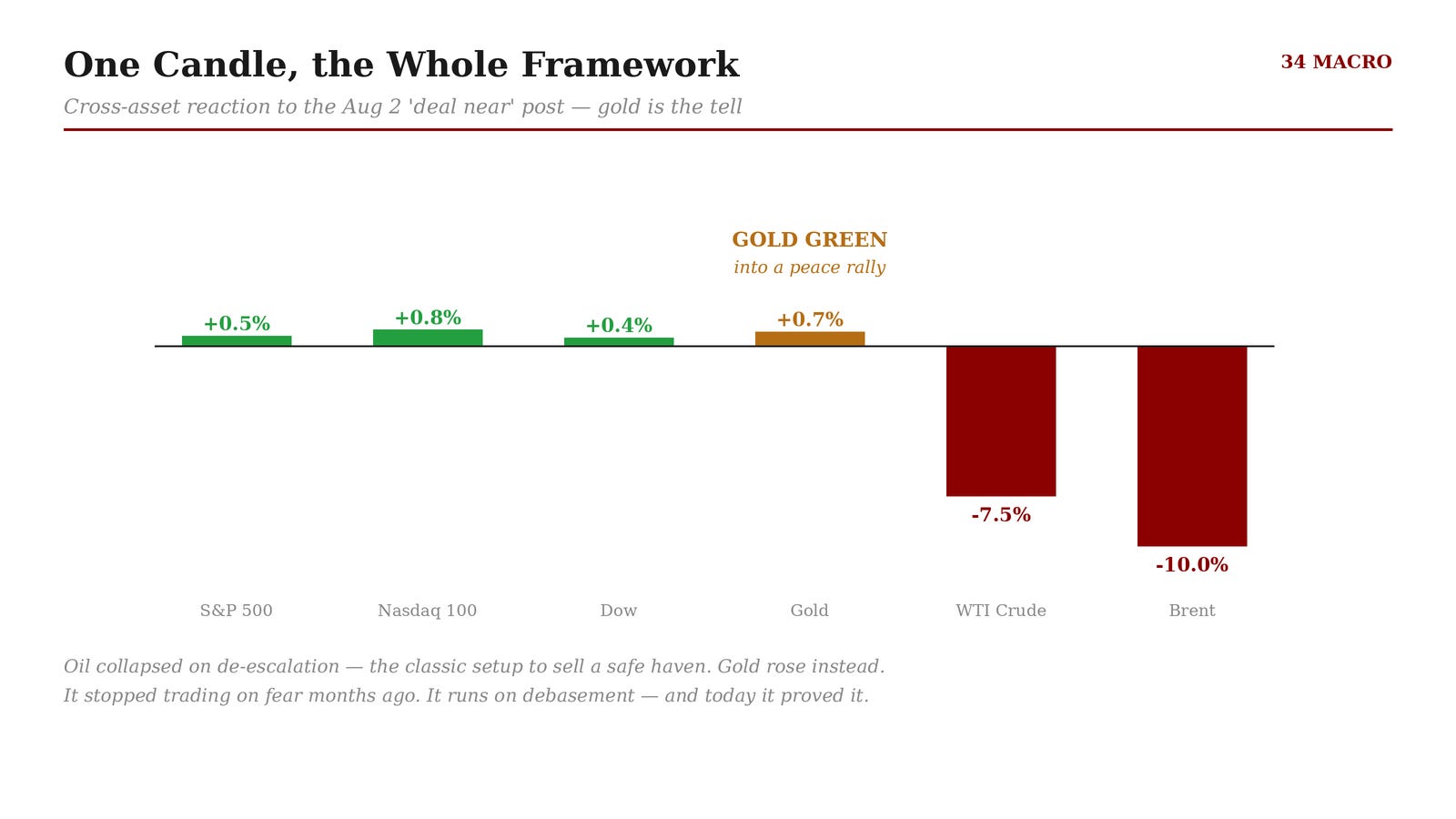
The Aug 2 cross-asset print on the “deal near” post: equities bid, oil collapses — and gold rises. The war premium bled out of crude while gold ran on its own engine.
Now connect the timing. The first ceasefire landed right into the June FOMC — pulling oil back just enough to hand the Fed cover to hold instead of hike. This new “deal in sight” burst is landing roughly three weeks before Jackson Hole, exactly where a well-timed oil pullback would give Warsh the room to soften the frame from “no tolerance” toward “we have made progress, we can be patient.” Trump does not need to permanently solve Iran. He needs to time the oil tape to the Fed calendar. Each “deal near” burst manufactures a tradeable oil pullback, and he can deploy one whenever the Chair needs cover.
I will hold the honest line, because the framework demands it: this is Trump’s claim, not a signed deal. Iran’s hardliners are already disputing it — the same split as every prior round. And this is at least the fourth iteration; the June version was actually signed at Versailles and still collapsed within three weeks. So the tell is not the announcement. The tell is whether oil pulls back and holds into late August, and whether Warsh cracks the door at Jackson Hole. If both, the strategic-dove thesis is playing out move for move, and the market’s hike-pricing was the fade of the year.
Jackson Hole is the next catalyst. Watch it.
The Metals Tell Two Stories
While everyone watches equities, the metals complex is quietly telling you the deepest part of the regime — and it decomposes into two separate trades.
Gold has left the safe-haven axis entirely. Since the Iran inflection, gold has not traded on fear. It trades on sovereign debasement — the fiscal and monetary path. The proof came on the cleanest possible test this Sunday Evening at Futures Market Open: oil collapsed eight to ten percent on a peace headline, and gold closed green, up 0.7%. If gold were still a safe-haven asset, de-escalation crushes it. Instead it rose while the war premium bled out of crude. Debasement gold does not care that the war is cooling; it is pricing the fiscal path, and today it proved it live. That is the same force lifting the 30-year yield — the debasement and term-premium story are one regime, read through two instruments.
And the complex splits. Copper versus gold is firm — holding its own. Silver versus gold is rolling over hard, breaking down on every near-term timeframe. If this were a simple “metals sold off” move, both ratios move together. They did not. The split is diagnostic: it rules out a generic industrial collapse (or copper would be falling hardest) and a generic monetary lift (or silver, half-monetary, would ride it). What is left is gold-specific. Silver, half industrial and half monetary, gets punished on its industrial half while its monetary half is not enough to hold it. Copper, pure industrial, holds because there is no supply problem. Gold is bid on the one thing that is purely gold — the debasement factor. The silver/gold collapse is the cleanest proof of all: if the bid were broad-monetary, silver rides it. It did not. The bid is specifically sovereign debasement.
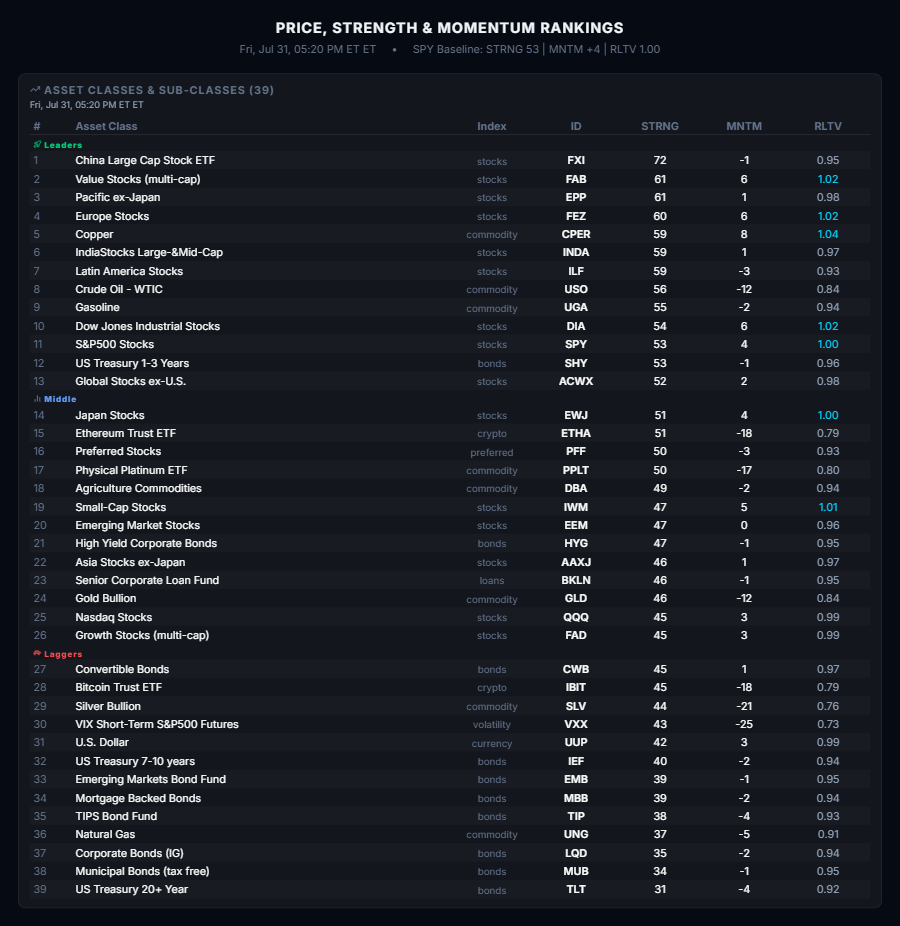
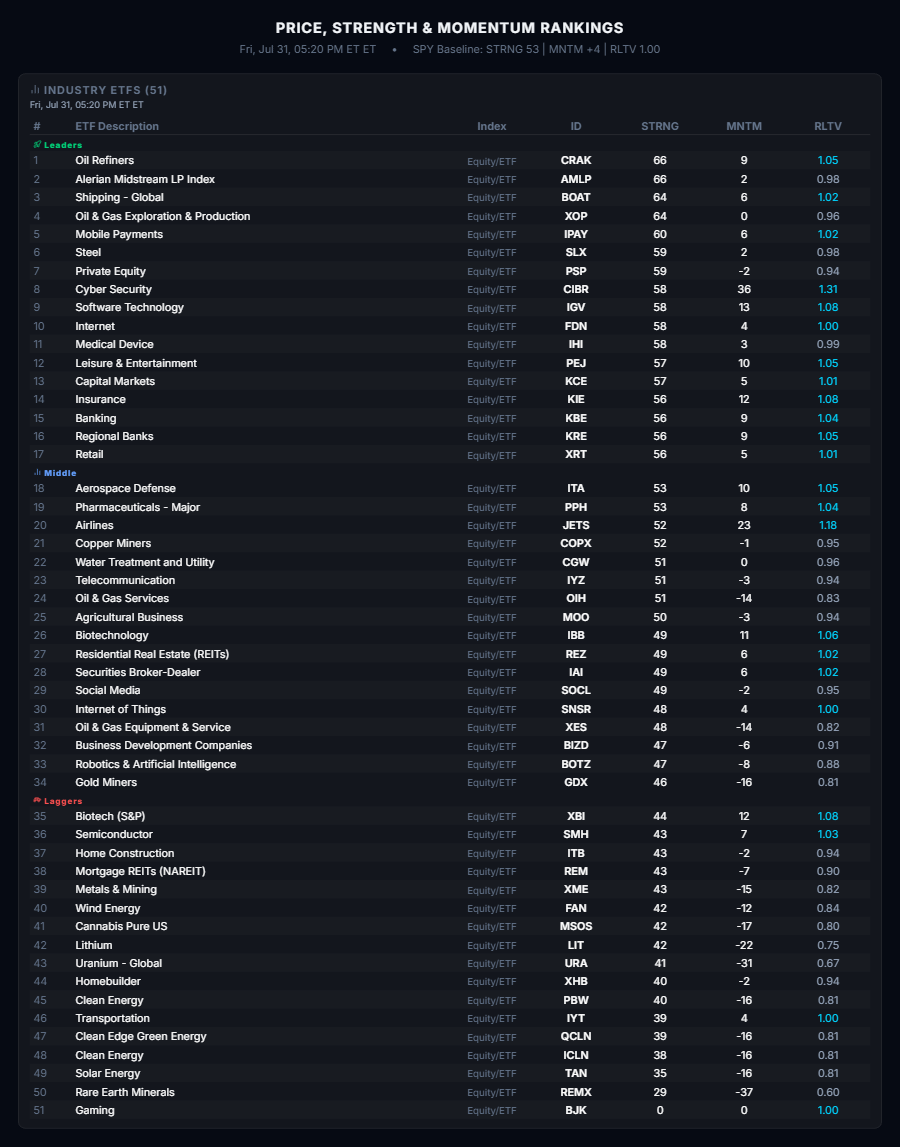
My own rankings confirm it at the instrument level. At Friday’s close, gold miners sat 34th of 51 industries with momentum at −16, and silver ranked 29th of 39 asset classes with momentum at −21 — both buried in the laggard bucket, while gold the metal held. The industrial-and-mining half of the precious complex is being sold. The pure-debasement half is not. That is the silver/gold rollover, printed on the board.
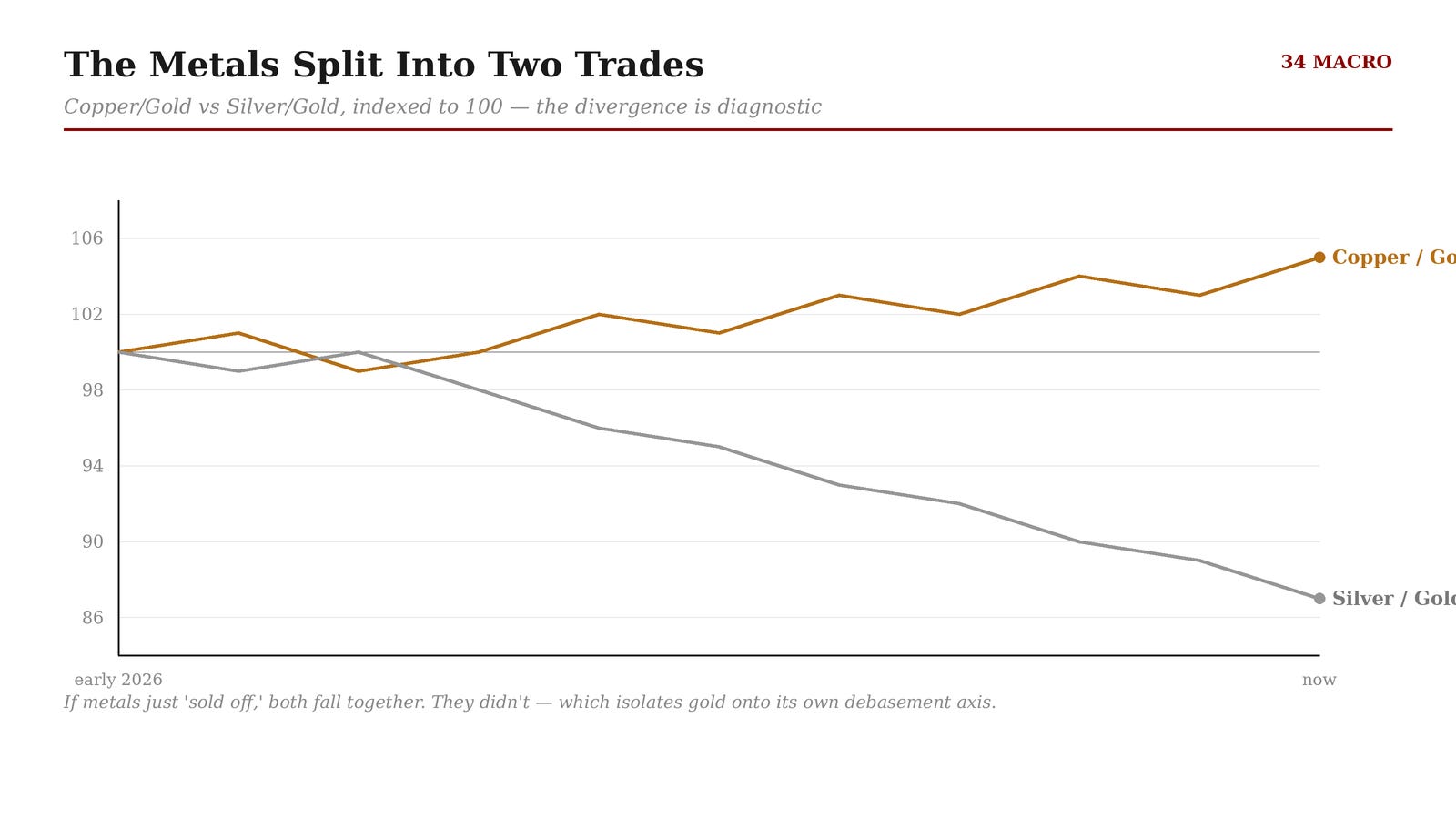
The metals decomposition: copper/gold firm (industrial bid intact), silver/gold rolling over (the hybrid punished on its industrial half). The split isolates gold onto a pure debasement axis.
The Industrial Bull Was Suspended, Not Killed
Here is the forward thesis the current tape is hiding. The industrial complex was in a bull market into early 2026 — ISM running hot, industrial prints strong across the board. The Iran shock spiked crude, and high energy costs are the single biggest destroyer of industrial margins. That crushed the trade. But that was a suspension caused by an energy shock, not a structural death.
Crude is now rolling over from the spike, with no underlying supply problem, which reopens the industrial-margin story. Layer the AI-infrastructure buildout — data centers and the sheer scale of grid expansion required to power them — and defense and munitions demand on top, and the industrial-metals bid re-establishes. Copper leads the confirmation. Silver and platinum follow.
And notice where that demand comes from: data centers, grid, munitions. This is the commodity expression of powering the models. The AI buildout does not just need chips and software. It needs power, grid, copper, silver, platinum. The same thesis that put me in the infrastructure and energy names is the thesis under the metals. My energy call, my Fed call, and my AI-infrastructure call all land on the same complex.
I built this around four triggers, in causal order, and they are resolving right now:

Precondition fired today. Permission is granted. The proof lands within days. And the leading indicator is already leaning the right way: on Friday’s board, copper the metal ranked a top-five asset class with positive momentum, outperforming the market — while the copper miners languished mid-pack and metals-and-mining sat near the bottom. That is the exact split my July work said to watch: the physical industrial bid holding while the mining equities lag. The confirm is in.
What My System Is Telling You
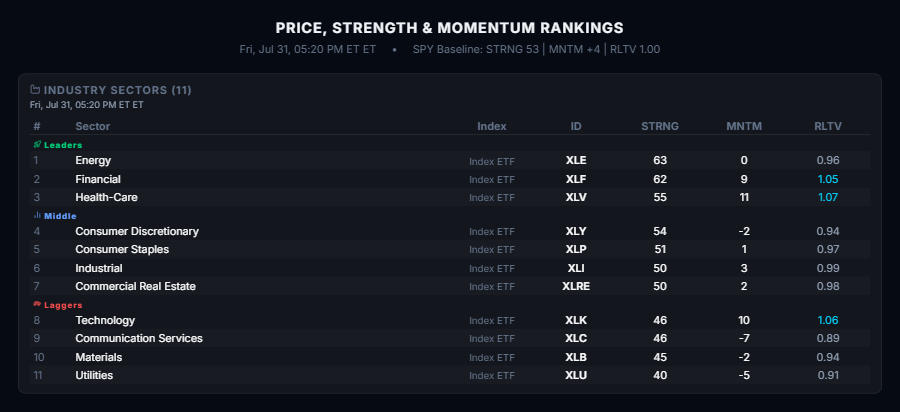
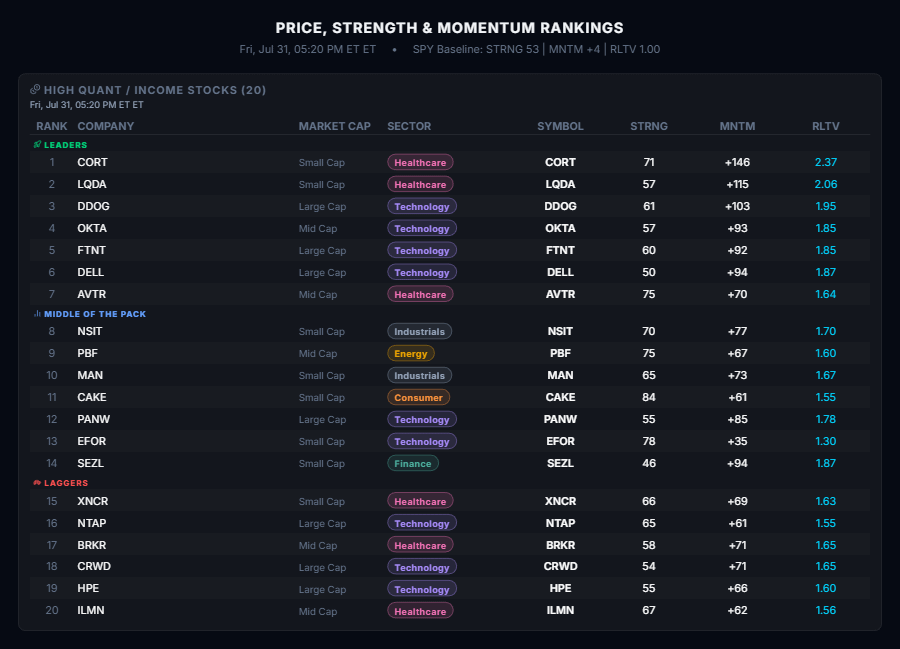
I no longer run anyone else’s institutional rankings. I built my own. The Price, Strength and Momentum model — my in-house dashboard — ranks every asset class, sector, and industry, plus a new high-income quant screen, through one engine, and it runs on a fixed six-gate spine: the clock, the fear variable, the phase, leadership, the wire and the bar, and the routed decision. This is the “even I am in the AI trade” point made literal. I am not citing a vendor. I am reading my own machine. Here is what it said at Friday’s close.
Gate 1 — The Clock. The catalyst cluster resolved. The FOMC on the 29th, immediately followed by PCE on the 30th — the twenty-four-hour decision-then-inflation window I pre-registered as the experiment — hit midweek and gave its verdict. This week’s signals are durable, not provisional positioning into a pending event.
Gate 2 — The Fear Variable. Fear absent. All week. Including the FOMC-day break to a new low. This is the systematic backbone of everything I argued above about Warsh. The market broke to a fresh low on the FOMC decision — and fear never came. VIX momentum was crushed every single session, including on both recovery days. Bonds never caught a safety bid: Treasuries sold off with stocks on the way down and stayed sold on the way up — no rotation to safety at any point. The dollar stayed weak. Across two breaks to new lows and a full recovery, not one of the three fear signatures ever fired. The whole market called the FOMC break distress. My model says it was a reset with no fear underneath it — which is the strategic-dove read, confirmed by an independent instrument.
Gate 3 — The Phase. Resetting, resolved up. The baseline arc tells the story: 45 to 47 to 39 on the FOMC break, then plus-ten to 49 on PCE, following through to 53 into the close — the highest reading of the entire stretch. A no-fear break is a reset, not a rollover. It resolved up and extended to a new high into month-end.
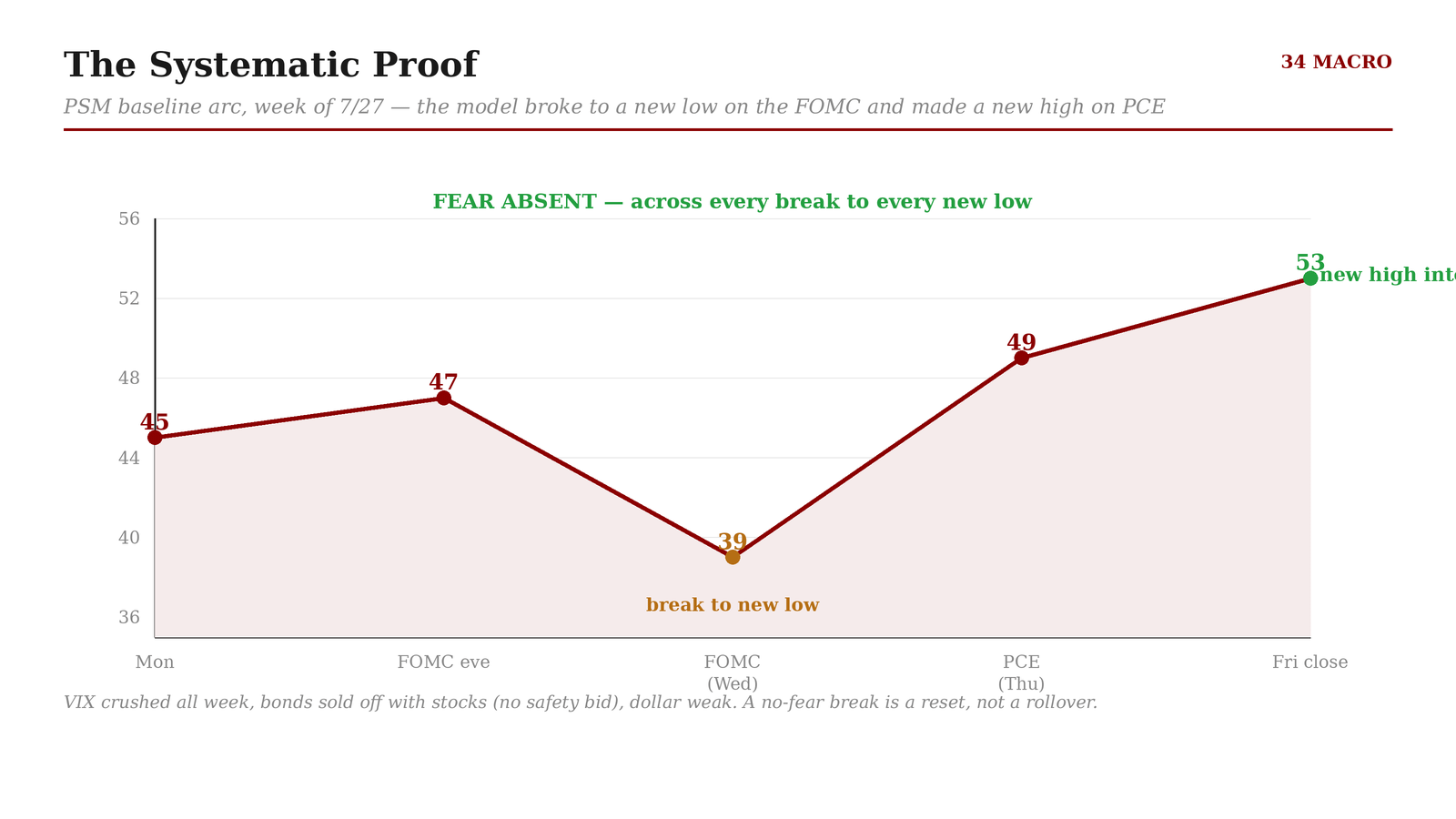
The systematic proof: the model’s baseline broke to a new low of 39 on the FOMC, then recovered to a new high of 53 on PCE — with fear absent through every break. A reset, not a rollover.
Gate 4 — Leadership. Cyclical and rate-sensitive, plus healthcare quality — confirmed at every level. The boards line up cleanly. In sectors, Energy is #1, Financials #2 with relative strength 1.05, and Health-Care #3 carrying momentum of +11 and the board’s best relative strength at 1.07. Cyclicals and rate-sensitives own the top; defensives do not. In the industry ETFs, the energy complex sweeps the top — oil refiners, midstream, shipping, and exploration and production at ranks one through four — with the income and rate-sensitive cluster right behind: insurance, banking, and regional banks at relative strength of 1.04 to 1.08. And cybersecurity sits eighth on a fifty-one-name board carrying the highest relative strength on it at 1.31, momentum +36 — the “protecting the models” leg re-firing. The tell to watch: that cyber and software surge is momentum-led, and strength has not yet confirmed. A momentum spike without strength does not last — I watched it round-trip once already this month in the semiconductors. So the tech re-fire is a signal, not yet a position.
And the read that matters most for the AI thesis: Health-Care took the number-one sector outright on the FOMC-day break — the first time a defensive led the board all stretch. Under the old logic, a defensive leading is a flight-to-safety warning. Read through the fear gate, with VIX crushed and bonds selling off, it is the opposite — it is AI broadening, not fear. Healthcare is a first-order AI beneficiary: undervalued versus its own history, rate-resilient cash flows, immediate AI-productivity upside. I posted exactly that thesis on December 28. The confirmation came the next session — Health-Care ceded number one back to the cyclicals within a day. A fear-driven crouch does not reverse in a day. It was rotation, not flight.


Gate 5 — The Wire and the Bar. Two disciplines fired this week, both correctly. The industrials trim wire armed on the break — a defensive took number one — but the wire is fear-gated, and with fear absent it did not fire. The condition reversed the next session; had I trimmed, I would have been wrong within a day. And the cannabis exit bar triggered on genuine sustained confirmation, and the reduce was executed. No front-running. Act on confirmation. The confirmations held.
Gate 6 — The Routed Decision. Hold the book. The reset-and-add thesis paid off. The one thing that would have flipped the read to rolling over — fear entering on the catalyst — never happened. The read carried into next week: a market that reset and resolved higher, with cyclical, rate-sensitive, and quality leadership intact.
And the new layer closes the loop. This is the third week I am running a high-income quant screen alongside the other three — income and quality names ranked by the same engine. Look at who leads it: it is dominated by healthcare and AI. The top name carries momentum of +146. Healthcare names carry the highest strength on the screen. Datadog, Okta, Fortinet, and Dell fill the technology leaders. And Palo Alto sits twelfth, carrying momentum of +85 and relative strength of 1.78 — my December cyber call, now leading the income-quant board. The yield-and-quality bid is not going to bonds. It is going to the exact rate-sensitive-plus-AI complex the entire thesis rests on. Four instruments, one tape, all aligned.
What the Smart Money Is Telling You
The best-informed player in the market just acted out this entire thesis, and the sequence is ruthless.
Leopold Aschenbrenner’s Situational Awareness — an AI-focused fund that grew to as large as $45 billion — was forced to sell its entire public stock book after steep losses, its leverage unwinding as AI-infrastructure longs fell and software shorts moved against it. Its AUM collapsed from $45 billion to roughly $10 billion in a month. Ken Griffin’s Citadel stepped in and bought the book, reported across WSJ, FT, Axios, and CNBC at somewhere between $10 and $16 billion of holdings.
Two things make this the tell. First, Griffin did not reluctantly absorb a book — Citadel already held some of the same AI-infrastructure bets, so he bought the exact trade he already believed in, at a discount, from a forced seller. He expects the sector to recover and has the balance sheet to wait. Second, and this is the ruthless part: reporting indicates Citadel was pushing surprise-rate-hike fears in the days before the AI trade broke and forced that fund to unload near the lows — then bought the assets that narrative was crushing. The same institution talking the hike risk up was positioned to buy the wreckage.
That is the whole cycle in one story. The over-levered were forced to sell at the bottom. The best-informed stepped in to buy it. My friends who went from $200,000 to $11,000 were on the selling side of that trade. The framework is what keeps you on the other side.
Griffin marked the bottom mechanically. My July models marked it analytically. Same conclusion, two different instruments.
The Loop Closes: The Bifurcation, Resolved
Everything above is the resolution of what I wrote on March 30 in The Bifurcation. Read it back and the threads all close:

I wrote then that holding rates while inflation rises from a supply shock means real rates tighten passively — that holding was the correct tool, not the emergency tightening of 2022. That was the seed of the entire Warsh read, written before he ever sat down. I wrote that the economy was splitting into a reflationary industrial-AI-defense side and a stagflationary consumer-energy side — and that split is now decomposed at the instrument level in the metals. I wrote that every market move was initiated by Trump’s Truth Social and that his body language said he wanted the deal — and that fired again today, on a candle. I wrote that the gold death spiral from $5,311 to $4,376 was running out of sellers — and that same gold is now on its own debasement island, printing green into a peace rally. I wrote that Japan was the wild card nobody was watching — and “Trump on yen: U.S. intervening” was a headline this afternoon.
I called the fault line in March. This is where it resolved.
Even I Am in the AI Trade
Here is the irony I cannot ignore. None of this — the models, the synthesis, the frameworks that held the book flat through the worst tape in years — happens without the AI system I built to do it. I built a dashboard that synchronizes all my information into one place, so I can assess the macro faster and cleaner than I ever could by hand. That system is what got me here.
So even I am participating in the AI trade. Not as a spectator analyzing the buildout from the outside — as a user, a node in the same infrastructure thesis I have been writing about since December. The AI buildout is not a stock. It is the tooling that is changing how the work itself gets done, mine included. Powering the models turns out to include powering this one.
The Path Forward
Capital preserved is only half the win. The other half is that I am now onsides — positioned in trades aligned with a macro that, from where I sit, almost nobody else has recognized: the Warsh strategic-dove path, the industrial-bull resumption, the metals decomposition, gold on its debasement axis, and the AI-infrastructure leg that powers all of it. Four months in the workshop did not just keep the book intact. It brought me out the other side early.
Here is what I am watching into the back half of August:
Crude holding the pullback below $79 — the precondition. The copper/gold ratio for the industrial confirm. The early-August ISM print for the proof. And Jackson Hole for whether Warsh cracks the door. If crude holds, copper confirms, ISM rebounds, and Warsh softens the frame, the priced hikes become cuts, the industrial bid re-establishes, and the debasement trade keeps running. That is the setup. The tape will tell us which pieces confirm.
Process Over Prediction
The portfolio held its value to within $275 while a crowded, levered market went to pieces. Gold bottomed exactly where the models said the sellers would run out. The metals split into the two trades the framework predicted. The best-informed money bought the bottom my system had already marked. And the Fed did precisely what I argued the supply-shock regime required — while the whole market called it a mistake.
None of that was a prediction. It was a process. Observe, hypothesize, test, refine. The four months of silence were the refine step. This is what the workshop was for.
Process over prediction. Data over headlines. Framework over fear.
Pressure, not panic. Regime, not reaction.
The goal is not for you to depend on me. The goal is for you to not need me.
Glossary
Playing the field, not the Fed. Warsh’s directive — and this newsletter’s principle. Price the economy off your own data and models rather than waiting for the Fed to signal. The absence of forward guidance is meant to force independent analysis, not to confuse.
Price, Strength and Momentum (PSM) model. My in-house ranking engine — built on my own dashboard, no longer any outside vendor. It scores every asset class, sector, industry, and a high-income quant screen on price strength and momentum, and routes a positioning decision through six gates: the clock, the fear variable, the phase, leadership, the wire and the bar, and the routed decision.
Fear gate. The rule that a defensive taking leadership only counts as a warning if a real fear signature confirms it — VIX bidding, bonds catching a safety bid, the dollar firming. With fear absent, a defensive leading is rotation or broadening, not flight. It is what kept the trim wire from firing on a false signal this week.
Term premium. The extra yield investors demand to hold a long-dated bond rather than rolling short ones. It rises when the future looks more uncertain or more inflationary — pushing the long end of the curve up on its own.
Bear steepener. When long-term yields rise faster than short-term yields. It can reflect distress, or — as now — more growth and term premium being priced into the long end. The reason matters more than the move.
Sovereign debasement axis. The idea that gold is pricing the fiscal and monetary path — deficits, currency dilution, real yields — rather than acting as a fear hedge. It explains gold rising even when geopolitical risk falls.
PCE methodology change. A September 30 revision by the BEA to how three PCE components are measured, expected to lower reported core inflation by roughly 0.1–0.2 percentage points. The prices did not change; the measurement did.
Copper/Gold vs Silver/Gold. Two ratios that split the metals complex. Copper/gold reads the pure industrial bid; silver/gold reads the industrial-versus-monetary tug. When they diverge, they isolate what is really driving the move.
Forced deleveraging. When a levered fund must sell into a falling market to meet margin calls — selling at the worst possible price because it has no choice. It is how the over-levered become the forced sellers at the bottom.
— 34 Macro
Pressure, not panic. Regime, not reaction.
Cross-asset macro research and education — built for the everyday person.
The information on this website/Substack is for information purposes only. Figures are the trader’s own; positions and views can change without notice. The Iran “deal” referenced is a claim disputed by Iranian officials as of publication, not a finalized agreement. Institutional transaction details are as reported by WSJ, FT, Axios, and CNBC. Verify the latest before. It is believed to be reliable, but 34 Macro does not warrant its completeness or accuracy. The information on the website/Substack is not intended as an offer or solicitation for the purchase of stock or any financial instrument. The information and materials contained in these pages and the terms, conditions and descriptions that appear, are subject to change without notice. Unauthorized use of 34 Macro websites and systems including but not limited to data scraping, unauthorized entry into 34 Macro systems, misuse of passwords, or misuse of any information posted on a site is strictly prohibited. Your eligibility for particular services is subject to final determination by 34 Macro and/or its affiliates. Investment services are not bank deposits or insured by the FDIC or other entity and are subject to investment risks, including possible loss of principal amount invested. Your use of any information which is proprietary to 34 Macro or a third-party information provider shall only be used on individual devices without any right to redistribute, upload, export, copy, or otherwise transfer the information to any centralized interdepartmental or shared device, directory, database or other repository nor to otherwise make it available to any other entity/person/third party, without the prior written consent of 34 Macro.
Solid read good sir. I think it’s important to stay flexible enough to profit regardless of which macro regime wins.
It’s not about predicting the future perfectly, but having enough conviction to stay in the race through times of uncertainty.
The markets reward those who: Recognize when the the environment changes, detach their identity from a single bullish or bearish thesis, preserve capital (like the two portfolios you’re showing more than likely you have liquid on hand) until high-probability opportunities emerge, size positions according to conviction instead of emotion (we’ve discussed this) and lastly, let evidence change their mind instead of ego.
Very solid read and looking forward to more work and dialogue with you old friend.
V/R,
~ Kiahl