

34 Macro / August 9, 2026 / The Inflation Gauntlet
Everyone Bought the Pivot
Friday morning the jobs report hit, and it was ugly. The economy added 23,000 jobs when Wall Street expected eighty. The prior two months got revised down by another 103,000. Payrolls — the number that’s supposed to tell you whether the labor market is breaking — came in soft, stale, and worse on a second look.
The stock market threw a party.
Palantir ran 10% on the day. Small-caps ripped, the miners flew, Tesla popped, gold and silver caught a bid. The whole risk complex lit up green on a bad number, and the logic was one word wide: cuts. A weak labor market means the Fed has to lower rates to protect jobs; lower rates mean money is cheaper; cheaper money means buy everything that’s rate-sensitive. Pivot. Relief. Off to the races.
One market didn’t send a card.
The bond market — the arena where interest rates are actually priced, by the people who trade nothing but interest rates — looked at the same jobs number and barely moved. And where it did move, it moved in a way that quietly called the whole equity party a lie.
That gap is this week’s entire story. Not the jobs number. The disagreement about what it meant. Everyone bought the pivot. The bond market priced the opposite. Somebody is bluffing — and by the end of this piece you’ll know who, why, and what settles it.
Look at the tape, not the headlines.
I Called This, and I Wasn’t Alone
Before I tell you what the bond market is saying, you should know the framework telling you has been reading this tape correctly the whole way up.
Two weeks ago, the market broke on the Fed. On July 29 the crowd was screaming rollover — the top is in, risk off, get out. I told you the opposite, and I laid it out in Playing the Field: this was a reset, not a rupture, and it would resolve higher. My model runs a single baseline number for the market’s health — think of it as a strength-and-momentum readout of the tape, zero to a hundred. It bottomed at 39 the day of the Fed break. Then it climbed: 49, 53, 59, 66. It closed Friday at 66 — the high — after a two-day midweek pause that resolved straight back up. A reset, then a resolve. Exactly the call.
The Valve played out the same way. The soft dollar I said would fund this bull was weak every single session last week. The leadership I said to own — the AI-infrastructure and industrial complex, copper — was the leadership on the board. Not a forecast. A read that printed.
Now here’s the part that matters more than my own scorecard, because one framework being right can always be luck. An entirely separate, decades-old Wall Street method confirmed the same call, on the same dates, measuring something completely different. William O’Neil’s Follow-Through Day — the canonical bottom-confirmation signal used by a large institutional crowd — looks for a major index to surge on rising volume a few days into a rally attempt. It fired August 4 on the Nasdaq. And it marked the same bottom (7/29), the same turn (7/30), and the same confirmation (8/4) as my model did. One method keys on price and volume. Mine keys on 52-week range position and momentum. They share no inputs, they run on different instruments — and they landed on the identical three dates.
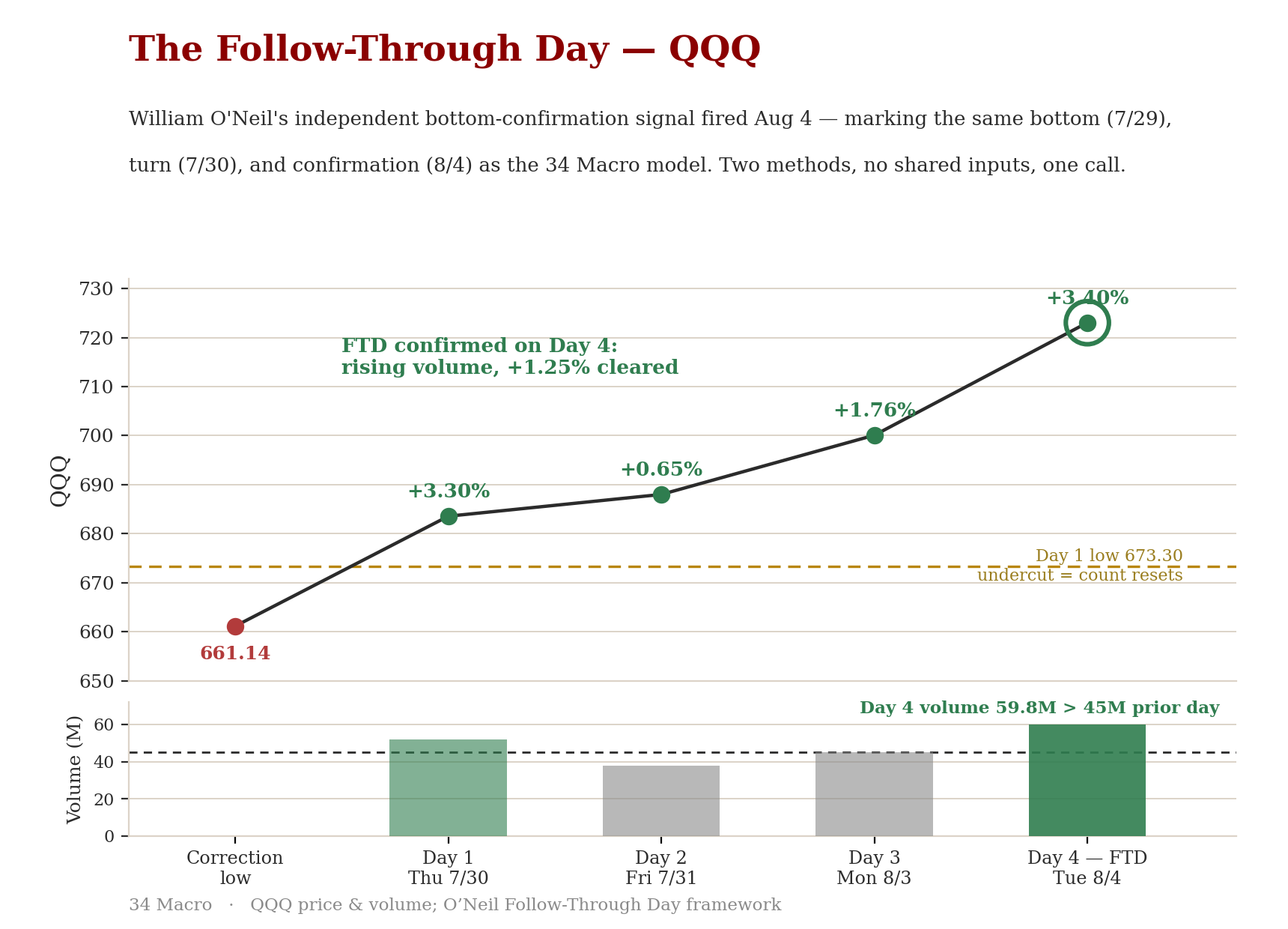
That’s not luck. That’s triangulation — the surveyor’s trick, where two fixed points nail down a third. When two methods that measure different things agree that precisely, the call is real, and a real institutional cohort is positioned long right alongside me.
I’ll keep the framework’s own honesty here, because it’s the same honesty this letter runs on: a Follow-Through Day confirms a bottom, it doesn’t guarantee one — plenty fail. But the point stands. The framework has read this tape correctly from the low. So when it tells you Friday’s celebration was a bluff, that’s worth sitting with.
The Fed That Can’t Move
To understand the bluff, you have to understand the Fed underneath it — because the bond market isn’t reacting to the jobs number in a vacuum. It’s reacting inside a regime.
Start with what happened on July 29. Fed Chair Kevin Warsh held rates steady — no cut — on a 9–3 vote. And the bond market threw a tantrum. The 30-year Treasury yield spiked to roughly 5.2%, its highest level in about nineteen years. Read that carefully, because the instinct is to read it wrong. Long-term yields didn’t blow out because the market thought Warsh was too hawkish. They blew out because the market is afraid he isn’t hawkish enough — that inflation is going to force his hand and he’ll have to do more, not less.
Here’s the trap Warsh is in, and it’s the center of everything. Call it the boxed Fed.
He can’t cut. Inflation isn’t dead — services prices are re-accelerating, and cutting rates into that would pour gasoline on it. But he also can’t easily hike, because the labor market is softening and hiking into weakening jobs is how you manufacture a recession on purpose. So he sits. Held. Pinned between two doors he can’t walk through.
Why can’t he fix it? Because of where the inflation comes from — and this is the one mechanic that unlocks the whole year, so let me define it plainly. There are two kinds of inflation. Demand-side inflation is too much money chasing too few goods — an overheating economy, a wage-price spiral. The Fed can kill that by raising rates to cool demand; that’s what 2022 was. Supply-side inflation is different: it comes from the cost of making and moving things — an oil shock, strained services capacity. Rate hikes can’t touch it. You can jack rates to the moon and it won’t produce a single additional barrel of oil. Hike into a supply shock and all you do is crush demand into an economy that’s already softening — you get a recession and you still have the inflation. That’s stagflation.
This week’s data drew the box exactly. Wages cooled — average hourly earnings came in at 3.2% against 3.5% expected — which means the demand-side, wage-driven inflation channel is fading. But the supply side is very much alive: services selling prices hit a four-year high, and oil is elevated on the Middle East. So the inflation that’s left is the kind the Fed’s only tool can’t fix. Cutting re-lights it. Hiking manufactures a recession. Boxed.
And this is why the market now prices a possible rate hike in September as roughly a coin flip — not because anyone thinks the economy is too hot, but because supply inflation might force Warsh to tighten into a weakening job market anyway. Hold that thought. It’s the key to the bluff.
Now the part nobody in a central bank is supposed to say out loud.
This week it came out — first in the Wall Street Journal, then confirmed by Bloomberg — that President Trump has been on the phone with Warsh regularly since he took the chair in May. The reporting is careful: Trump has been asking about Warsh’s forecasts and views, not ordering a specific rate path, and it’s unclear whether the two have discussed monetary policy directly.

Then on Friday, the administration’s own top economist, Kevin Hassett, went on Bloomberg TV and volunteered more: Trump and Warsh have a close, long-standing relationship and talk about the economy “all the time” — and, in the same breath, that he’s “sure” the President isn’t telling Warsh what to do about interest rates.

Notice the shape of that. When a White House volunteers a denial about steering rates that nobody formally demanded, the denial is the tell. You don’t preemptively insist you’re not doing the thing unless the thing is the obvious read of the setup.
But I’m going to hold an honest line, because the credible version of this argument is stronger than the conspiracy version, not weaker. A President and a Fed chair talking is not, by itself, proof of dictated policy — presidents have talked to Fed chairs before. My point doesn’t need a smoking-gun phone order, and it’s sharper without one: it doesn’t matter whether Trump is dictating rates, because the outcome aligns either way. Warsh’s boxed posture — hold, don’t cut into supply inflation, tolerate a soft dollar, keep the tape supported — is precisely what the White House wants. Whether that arrives by instruction or by a like-minded chair who talks to the President “all the time” is almost beside the point. Capture doesn’t require an order. It requires alignment. And Hassett handed us the alignment in one line: there’s finally someone at the Fed, he said, the President is “100% sure is going to do what’s right based on the numbers.”
That’s the regime. A Fed that can’t move, pinned by an inflation it didn’t cause, run by a chair who is aligned with the administration by relationship rather than by order. Higher-for-longer — meaning rates staying elevated for an extended stretch rather than getting cut — with a live hike tail on top. This is the ground the bluff is standing on.
(If this sounds familiar, it’s the machine I sketched in The Bifurcation — the split between a stagflation path and a reflation path. Now you can see why it wouldn’t resolve: the Fed can’t resolve it. Only the data can.)
The Bluff
Now we can name it.
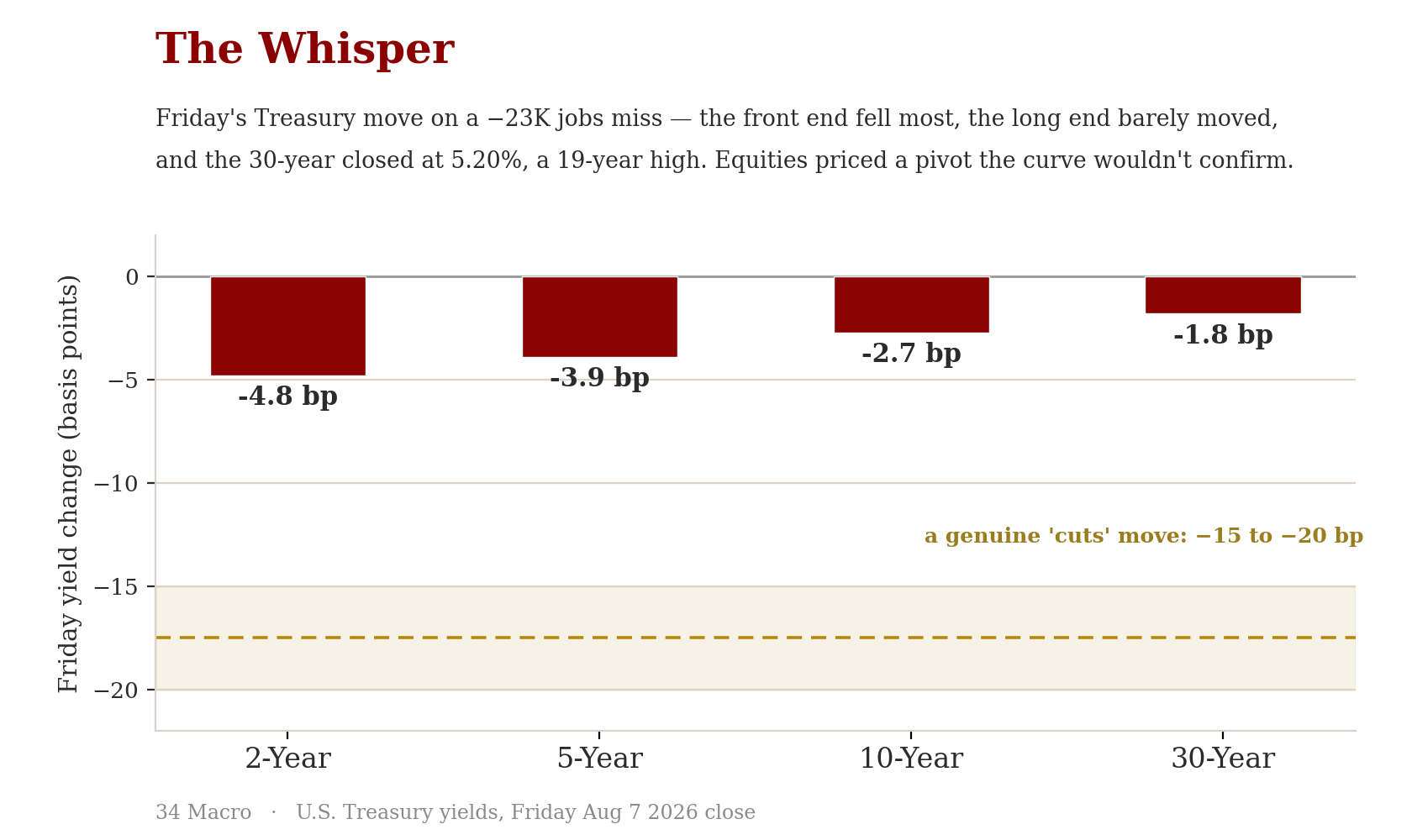
Go back to Friday. A weak jobs number. If the bond market genuinely believed a rescue-cut cycle was beginning — that the Fed was about to ride to the rescue — you would see a violent move. The front end of the curve (the 2-year Treasury, which tracks what the Fed is expected to do) would reprice hard, dropping 15, 20 basis points as it priced in cuts. And if the market smelled real trouble, money would stampede out of stocks and into Treasuries for safety — a flight-to-safety bid that drags long-term yields down too. That’s what “cuts are coming” looks like in bonds. Loud. Violent. Unmistakable.
Here’s what actually happened Friday. Yields fell — but by a whisper. The 2-year dropped less than five basis points. The 10-year, under three. The 30-year — the long bond — barely moved at all, down under two, and closed the day sitting at 5.20%, right at its nineteen-year high. There was no stampede. No rush to safety. The bond market got handed a jobs number that missed by roughly a hundred thousand and it shrugged — a small, orderly, almost bored little bid.
Two things in that non-reaction, and both are the signal.
First, the bond market refused to flee. On a genuinely scary labor print, the move that matters most is the one that didn’t happen — no panic into safety. The bond market didn’t believe the number was scary, because unemployment actually fell to 4.1% (the softness was people leaving the workforce, not a wave of layoffs), the Sahm rule — a recession trigger that fires when unemployment rises fast off its lows — didn’t trip, and jobless claims are sitting at 199,000. No recession, no rescue needed. The bond market’s first message: this is normalization, not collapse.
Second — and this is the kicker — the long end held 5.2%. It refused to lower its view on inflation, because the inflation problem is supply-side and a soft jobs number doesn’t touch it. The curve isn’t pricing “no cuts.” Remember the coin-flip: it’s pricing a possible hike.
Put those together and you have the bluff, in one sentence. Equities spent Friday buying rate relief while the only market that actually trades interest rates was pricing the opposite tail — a hike. The stock market took a five-basis-point whisper and built a full pivot rally on top of it — Palantir up ten percent — extrapolating cuts that the bond market was, at that very moment, pricing out. One of these two markets is wrong about what Friday meant. And when the disagreement is between the equity crowd’s story and the rates market’s money, I will take the side of the people who trade the actual instrument every single time.
This isn’t “stocks are dovish, bonds are hawkish” — both markets ticked in the dovish direction on the day. The divergence is magnitude. Bonds whispered. Equities shouted. And the shout is the bluff, because the whisper is all the evidence there was.
The tell, to say it the way it deserves to be said: the bond market not fleeing to safety is the signal. It looked at bad news and decided it didn’t need to hide. That tells you it doesn’t believe the bad news changes the thing that actually matters — the inflation the Fed can’t fix.
The Number That Settles It: August 12
A bluff gets called at a specific moment. This one has a date: Wednesday, August 12.
That’s when July’s Consumer Price Index — CPI, the headline inflation number — is released. And inside it is the one figure that settles the whole argument: supercore.
Let me define it, because it’s the most important word in the piece and almost nobody explains it. Inflation gets sliced into layers to strip out the noise. Headline is everything, including food and energy — loud but jumpy, because an oil spike swings it around. Core is headline minus food and energy, to see the trend underneath. Supercore goes one cut deeper: it’s core services minus housing. Why carve that out? Because it’s the cleanest possible read of domestic, demand-driven inflation — the price of haircuts, restaurants, insurance, medical care, the labor-heavy services that reflect genuine demand in the economy. It strips out housing (which lags reality by many months and muddies the read) and goods (which are about global supply chains, not domestic demand). Supercore is the number that answers the Fed’s actual question: is there still real, homegrown heat in this economy, or not?
That’s why it’s the arbiter. Headline could run hot next week purely on oil — but that’s the supply-side kind the Fed looks through. Supercore is the part it can’t ignore.
Two ways it breaks:
Hot supercore — services inflation still running — validates the bond market. The hike tail hardens, the long end resumes selling, higher-for-longer is confirmed, and Friday’s dovish-equity pop unwinds. The reflation trade — cyclicals, value, energy, financials — re-leads. This is the branch the tape is quietly pricing.
Cool supercore — the domestic engine genuinely softening — is the surprise almost nobody is positioned for. That’s the print that lets the front-end whisper become a real dovish move: bonds finally bid for real, the dollar softens further, long-duration growth leads. The dovish-equity crowd would, in that one scenario, turn out to have been early rather than wrong.
And there’s a second event the same morning that makes August 12 even richer: a 10-year Treasury auction. An auction is simply the government selling new bonds, and the demand at that sale is a real-money referendum — investors voting with actual capital on whether they still trust this Fed to control inflation after the post-FOMC blowup. Weak demand (buyers demanding higher yields to show up) confirms the bond market’s distrust and the higher-for-longer read. Strong demand complicates it. Two verdicts, one day: the inflation print and the confidence vote.
The single tell to watch before Wednesday: do bonds start to bid as CPI approaches — the front end firming, the long end following — which would mean the dovish case is quietly building? Or do they stay offered, the long end stuck at 5.2%, which means the hike tail is alive and the bluff is about to get called? Right now, they’re offered. Right now, the bond market is holding its ground.
What the Tape Is Already Saying
Step back to the whole board, because the equity market isn’t only bluffing — parts of it are quietly confirming the bond market’s read, and that’s the cross-asset confirmation this framework hunts for.
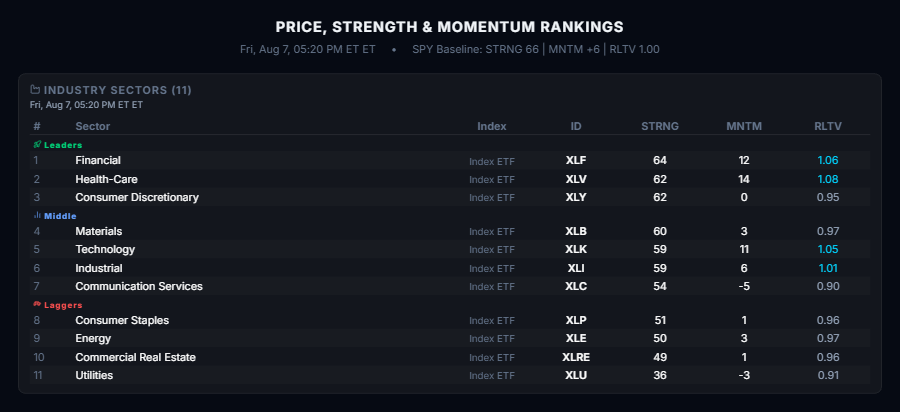
Look at what led all week. The number one sector, every single session, was Financials. That is not trivia. Banks make money on the spread between what they pay for short-term deposits and what they earn lending long — that spread is called net interest margin, or NIM, and it’s basically the slope of the yield curve. When the gap between short and long rates widens — a steepener — bank margins widen with it. So when Financials lead, the equity market is voting for exactly the world the bond market is pricing: rates staying high, the curve staying steep, higher-for-longer holding. Two different markets, same regime call. The banks are betting on the same thing the long bond is.
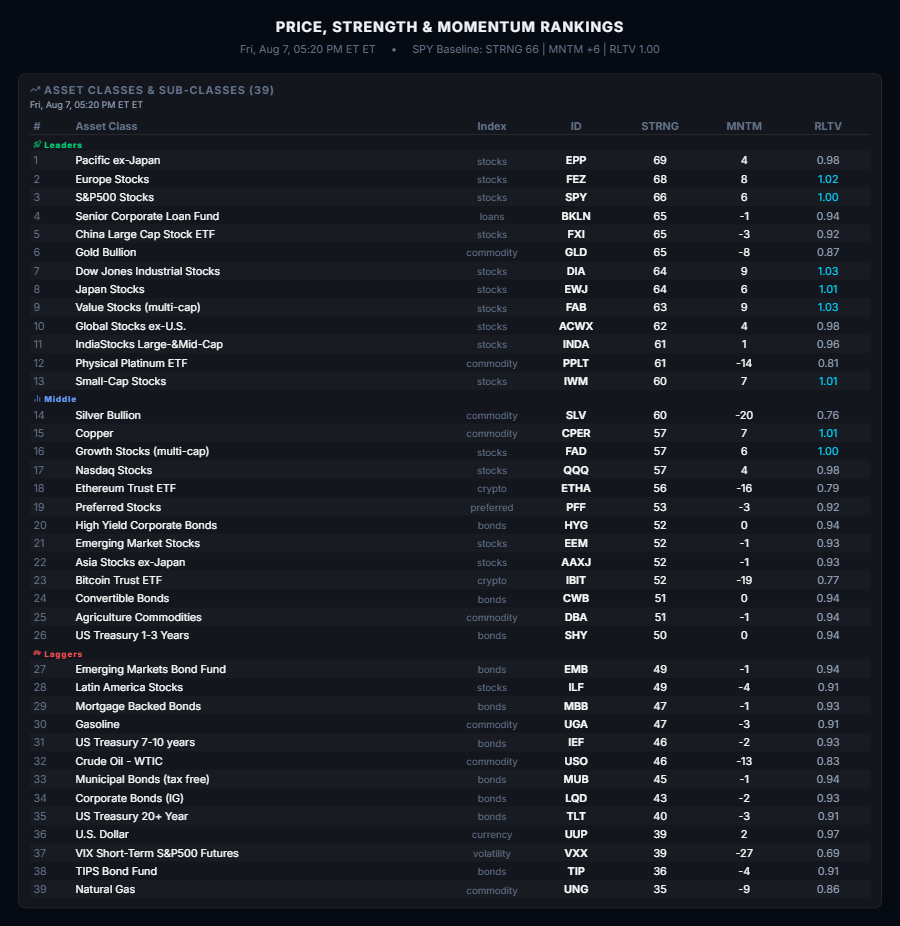
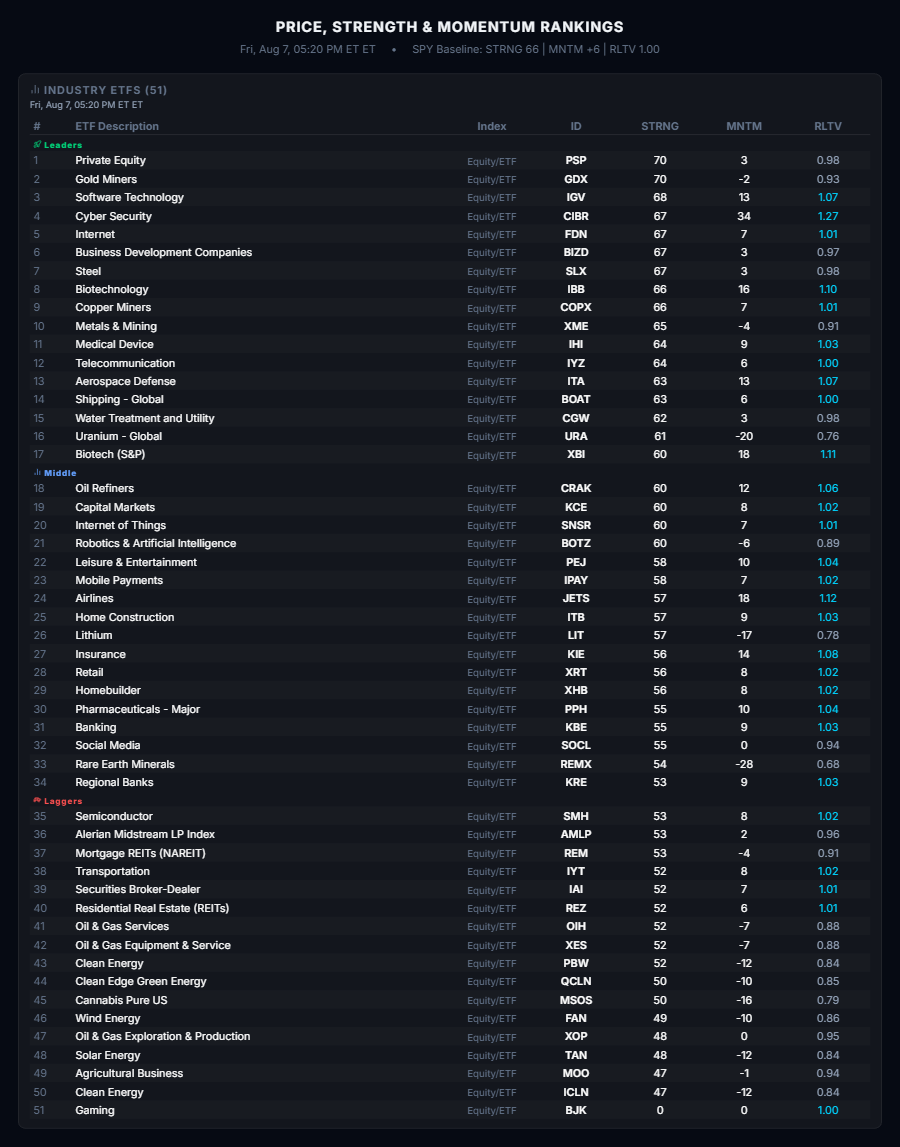
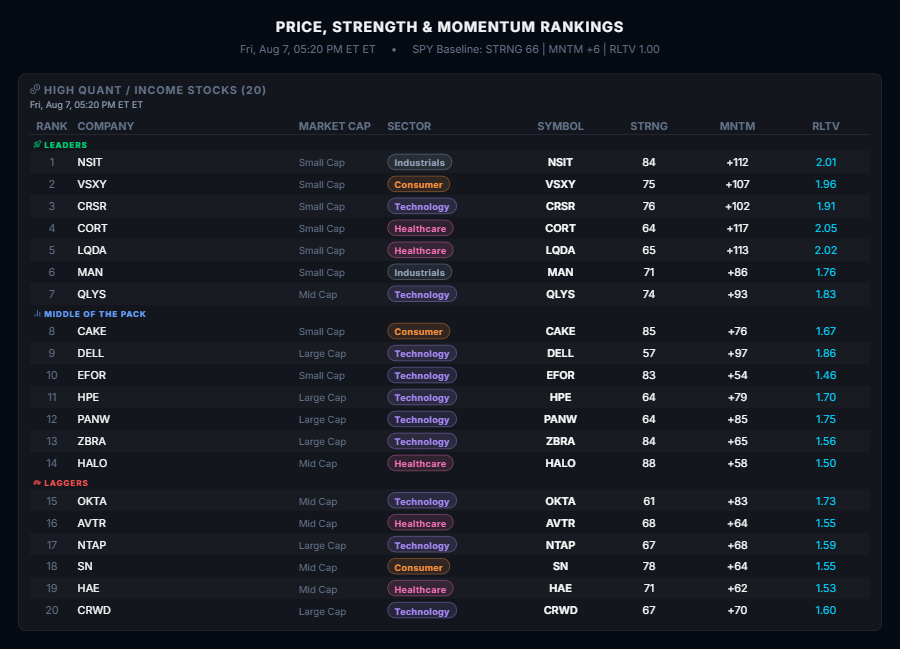
And the leadership underneath was broad and healthy — the opposite of a market narrowing into a top. Health-Care held the number two sector with the board’s best relative strength. (RLTV is my relative-strength read — above 1.00 means the group is outperforming the broad market; Health-Care closed at 1.08.) The quality bid deepened right down into higher-beta biotech. The reflationary-metals theme surged — gold miners number two on the ETF board, copper miners and steel in the top ten. Industrials held up. The single-stock screen was the widest it’s been all stretch, fresh leaders rotating in across four different themes. This is a broadening advance, not a fragile one.
I’ll give you the one honest open thread, because a highlight reel isn’t what we do here. The chip stocks haven’t confirmed. Semiconductors are grinding higher but still lagging on the board — the semis ETF sat at number 35 even as it firmed into Friday’s close. Technology as a sector clawed back to number five. So application-layer tech — software, cyber, internet — is confirmed leadership, but the chips underneath are a live watch, not a resolved call. I’m telling you what hasn’t worked yet, not just what has.
How I’m Playing a Fork I Refuse to Guess
Here’s the whole point of everything above: I don’t have to know which way CPI breaks. The book is built so most of it wins — or holds — either way. A barbell, hedged across the fork. Let me walk it, sleeve by sleeve, with the real names and where they actually sit.
Metals and miners are the MVP, and the boxed Fed is the reason. This is the one sleeve the whole analysis makes stronger, not more complicated. Gold pays in both branches: hot supercore and it’s an inflation hedge; cool supercore and it’s falling real yields plus a softer dollar. And underneath both sits the debasement bid — a Fed that won’t fight supply inflation and quietly wants a weak dollar is a standing tailwind for hard money. It’s my highest-conviction sleeve and it’s carried the book: First Majestic silver up 204% from my cost, Newmont up 124%, AngloGold up 41%, the gold ETF up 48%, and Freeport — my copper name, and copper is its own reflation-and-grid story — up 17%. On the board, gold miners closed the week at number two. Nothing here says trim.
The AI-power complex is bigger than most people’s version of it — and higher-for-longer helps it. The obvious read is that high rates hurt long-duration growth. But the picks-and-shovels of the AI buildout — the companies wiring, powering, and cooling the data centers — behave differently: higher-for-longer kneecaps the speculative, long-duration competition they screen against, and the capex doesn’t pause just because money is expensive, because the buildout is a multi-year commitment, not a quarterly discretionary spend. I own the whole chain. The electrical and power-infrastructure names — Emcor, Eaton, Powell, Argan, Solaris, Modine for cooling, Constellation for the nuclear power feeding it all. And I own the buyers too — Microsoft, Amazon, Alphabet (up 127% from cost), Meta, Nvidia, Broadcom — the hyperscalers writing the capex checks. That’s a deliberate structure, and it comes with a specific risk I watch closely, which I’ll get to.
One refinement that matters, because it’s honest: the enablers are not all pure AI plays. Emcor is a diversified electrical and mechanical construction and facilities-services company — data centers are one end market among many. Argan builds power plants across the whole energy and grid buildout, not only for AI. So even if AI-capex sentiment cracks, those two have diversified revenue underneath them. The AI risk is real, but it doesn’t hit them the way it hits a pure-play.
Energy and cyclicals are the hot-CPI hedge — and here’s my read on the oil shock: it’s real, but it’s on a timer. The supply-side inflation keeping the Fed boxed is largely oil, and oil is largely the Middle East. As that conflict recedes, the shock decays. That’s why I lean the regime toward reflation over stagflation — the stagflation tail is fading, not building. But while it’s live, this sleeve is my protection if supercore runs hot: Caterpillar up 90% from cost, Schlumberger up 38%, EQT in natural gas. It lagged Friday’s dovish pop, which is exactly what a hedge is supposed to do.
Defense and aerospace are their own leg — RTX up 46%, AAR up 92%, BWXT in the nuclear supply chain — riding the structural rearmament and grid-security spend that doesn’t much care about the CPI print.
Healthcare is my defensive-growth sleeve, and it’s where the cool-CPI branch pays. Welltower is a healthcare REIT — a real-estate company that owns senior-housing and medical properties and passes the rental income through to shareholders. As a REIT it’s rate-sensitive, so it’s my one genuine rate-relief beneficiary: if CPI cools and cuts come back into view, it gets a real bid. But I don’t own it for the macro call — I own it for its own engine, the demographic wave of aging boomers driving senior-housing demand faster than new supply can be built, which is why it’s up 17% from my cost even with rates pinning REITs generally. Gilead sits alongside it. Together they tie straight to the Health-Care leadership the board showed all week.
The cool-CPI counterweights are deliberate ballast. Sabesp — a Brazilian water utility, low-volatility, the position built to win if the bond market’s whisper turns out right and CPI cools (rate relief plus a soft dollar plus emerging-market inflows). And the long-duration growth names — Palantir, Oracle, Tesla — which win outright only on a cool print. Palantir ran 10% Friday on the dovish pop; that’s exactly the kind of parabolic move I trim into strength, because it’s priced for a relief the bond market hasn’t confirmed.
Emerging markets ride the soft dollar — the one macro call I hold with the highest confidence, because reflation runs a weak dollar and Friday confirmed it again. Japan (up 42%), Atour in the Chinese consumer (up 29%), Jumia and Baidu on the higher-risk end. This sleeve works regardless of which way the fork breaks.
And a couple I own purely for the business, not the regime — Garmin, the quality compounder that just confirmed its own thesis on a blowout quarter and raised guidance, up 30% from my cost; Casey’s, up 59%. These are the names that pay because the company is executing, full stop. That’s the whole discipline in one line: know why you own each thing. Garmin and the AI enablers are both “tech-adjacent,” but I own the enablers for a macro regime and watch capex for the risk, and I own Garmin for a business and watch valuation for the risk. Same book, opposite reasons.
Now the two things I’m watching that would override the entire fork — because these don’t change the tilt, they change the regime.
The first is the AI-capex kill switch. The healthy signal is a hyperscaler reporting strong capex and the enablers rallying on it — the buildout is real, the sellers get paid. The kill switch is a hyperscaler reporting strong capex and the enablers selling off anyway, alongside it — which means the market has stopped rewarding the spend and started punishing it as money-losing. When capital sells the buyer and the sellers on the same news, that’s not rotation, it’s the whole AI trade being re-rated. Watch how Emcor, Eaton, Nvidia, and the cooling and power names trade on Microsoft’s and Amazon’s next capex guides. If they sell with the hyperscalers, I fade the AI sleeve even if CPI comes in hot — because at that point its risk isn’t rates, it’s revenue. And because I own both sides of that chain, this is the watch I take most seriously.
The second is the credit tripwire — the single cleanest recession gauge there is. It’s a spread called high-yield OAS — the extra yield that junk-rated corporate bonds have to pay over safe Treasuries to compensate for default risk (the market ticker is BAMLH0A0HYM2). When the economy is fine, that spread is tight; right now it’s sitting around 270 basis points, which is calm. When recession odds rise it widens — and it widens before stocks roll over, which is why it’s a leading tripwire and not a coincident one. I don’t have to watch the index tick by tick; I watch the junk-bond ETFs it drives — HYG and JNK — because they fall when the spread widens, and they roll over ahead of equities. The confirming combination: HYG and JNK falling while investment-grade (LQD) holds, the Treasury complex (TLT, IEF) finally catching the safety bid it refused all week, and the most credit-sensitive stocks — the regional banks (KRE) and the business-development companies — selling off first.
That last one deserves a definition, because it’s the backbone of my income exposure. A business-development company, or BDC, is a publicly traded firm whose entire business is lending to small and mid-sized private companies — you buy the stock and effectively become the bank, collecting the interest as a dividend, since BDCs are required to pay out most of their income. They love high rates (their loans are floating-rate, so they earn more as rates stay up) but they fear recession (their borrowers are exactly the leveraged, below-investment-grade names that default first). That two-sided bet — high rates, healthy economy — is the reflation thesis in a single instrument, which is why they sit in my rate-and-credit-sensitive sleeve alongside the banks and insurers. And it’s why the day credit cracks is the day that whole sleeve turns.
None of it is firing now. Spreads are tight, the enablers are holding, the tape is broad. Which is precisely why the recession tail stayed dead this week — and why the fork, not a crash, is the thing to trade.
The Ledger
The framework isn’t a paper exercise. It runs the Black Star family accounts — my parents’ retirement, my kids’ futures — and I show the real numbers, up periods and down.

From the March 30 baseline — the depth of the drawdown, when I went quiet and rebuilt the system instead of forcing trades — the total family book is up more than $29,000. The All-Weather portfolio carried it, up over $16,000 as the regime it was positioned for came back around. And the higher-octane options book, which had been red, closed green — up $1,786 across the stretch. Every sleeve up. The reset-and-resolve paid across the whole book.
Not the biggest number in the melt-up — a macro book never is. It’s not built to print the flashiest return when everything is ripping; it’s built so that when the tape breaks and everyone else is forced to sell the lows, you’re still standing, capital intact, positioned for the turn. That’s what these numbers are. Capital preserved through the break, compounding through the resolve.
The Week Ahead: The Inflation Gauntlet
Last week established the regime. This week tests it — I call it the Inflation Gauntlet, and it runs in a clean causal order.
Monday and Tuesday are the quiet before it — Fed speakers set the tone, but the calendar’s heavyweight is still ahead. Then Wednesday, August 12, is the fulcrum: CPI, and supercore is the arbiter — hot confirms higher-for-longer and the hike tail; cool is the surprise the tape isn’t positioned for. The same morning, the 10-year Treasury auction is the confidence vote on Warsh — real money deciding, in real time, whether it still trusts this Fed to control inflation. Two verdicts before lunch. Then Thursday, August 13, is the follow-through: PPI — wholesale inflation, the prices businesses pay upstream, a check on whether the CPI read holds in the pipeline — lands alongside jobless claims, the labor backstop. Stable claims and the “rolling, not breaking” read holds; rising, and the recession conversation gets real regardless of what CPI printed.
And above all of it sits the one override that trumps the fork: if the credit tripwire fires — high-yield spreads widening off their lows while claims turn up together — then “rolling, not breaking” has become “breaking,” and the whole book rotates to defensives and quality, and the banks lose their steepener tailwind. That’s not a tilt. That’s a regime change, and it’s the one thing I’m watching above the inflation print.
The single best early-warning tell through all of it is the bond tape itself. Do bonds start to bid as CPI nears — the dovish case quietly building — or do they hold offered, the long end stuck at 5.2%, the hike tail alive? That question resolves the fork before the number even prints. Right now, the answer is: offered. Right now, the bond market is holding its ground and calling the bluff.
Process Over Prediction
None of this was a prediction. The reset that resolved higher, the leadership that led, the bottom that O’Neil’s method marked on the same three dates as mine — that wasn’t a crystal ball. It was a process: observe the tape, form a hypothesis, test it against the data, confirm it or throw it out. The same method my father used as a scientist, pointed at markets.
The bluff isn’t a prediction either. I’m not telling you I know what CPI will print. I’m telling you what the tape is telling you right now, against what the headlines are telling you — and right now the headlines say “pivot” while the bond market prices a hike. When those two disagree, you side with the market that trades the actual instrument, and you position for the fork instead of guessing the number. That’s the entire edge. Not knowing the future. Reading the present correctly while everyone else reads the headline.
The macro told you before the news. The reset was a reset. The dollar stayed soft. The leadership held. And Friday, when the crowd bought the pivot, the curve called the bluff.
The goal was never for you to depend on me. The goal is for you to read this tape yourself — to see a green day on a bad number and know to ask what the bond market did before you celebrate. Process over prediction. Data over headlines. Framework over fear.
August 12 is the reveal. I’ll be watching the bond tape into it. So should you.
Glossary
Follow-Through Day. A bottom-confirmation signal (William O’Neil / IBD) that fires when a major index surges on rising volume several days into a rally attempt. An independent, price-and-volume method — used here as external corroboration, not a core input.
Higher-For-Longer. The regime where the Fed holds interest rates elevated for an extended period rather than cutting — because inflation is too sticky to cut into.
Boxed Fed. A central bank stuck holding: unable to cut (it would re-stoke inflation) and unable to hike (it would break a softening labor market) — pinned by supply-side inflation its only tool can’t fix.
Supply-Side vs. Demand-side inflation. Demand-side comes from too much money chasing goods (the Fed can kill it by hiking). Supply-side comes from the cost of making and moving things — oil, strained capacity (rate hikes can’t touch it).
Supercore. Core services inflation minus housing — the cleanest read of domestic, demand-driven inflation, and the number the Fed watches most closely. The arbiter of the CPI fork.
Front End / Long End. The short-maturity part of the yield curve (the 2-year, which tracks Fed-policy expectations) versus the long-maturity part (the 30-year, which tracks inflation and term premium).
Bull Steepener / Bear Steepener. Both describe a steepening curve (short and long rates diverging). A Bull Steepener steepens because short rates fall (dovish); a Bear Steepener steepens because long rates rise (hawkish / inflationary).
Term Premium. The extra yield investors demand to hold a long-dated bond rather than rolling short ones — it rises with inflation risk and uncertainty, pushing the long end up on its own.
Net Interest Margin (NIM) / Steepener. NIM is the spread a bank earns between short-term funding and long-term lending — essentially the slope of the yield curve. A steeper curve widens NIM, which is why banks lead when the curve steepens.
RLTV. My relative-strength reading — a group’s performance versus the broad market. Above 1.00 is outperformance.
High-Yield OAS. The spread junk-rated corporate bonds pay over Treasuries to compensate for default risk (index: BAMLH0A0HYM2) — the cleanest market-priced recession gauge. Watched live through the HYG and JNK ETFs.
Business-Development Company (BDC). A publicly traded lender to small and mid-sized private companies that pays out most of its income as dividends — earns more as rates stay high, but is exposed to recession through its below-investment-grade borrowers.
Rate/Credit-Sensitive Sleeve. The cluster (banks, BDCs, insurers) whose returns depend on rates staying high and credit staying calm — its leadership confirms the higher-for-longer regime, and its breakdown is an early recession warning.
Sahm Rule. A recession trigger that fires when the unemployment rate rises quickly off its recent low. It did not fire this week.
— 34 Macro
Pressure, not panic. Regime, not reaction. Black Star In-House Model · The reset resolved. The dollar held soft. Now the curve calls the bluff.
Cross-asset macro research and education — built for the everyday person. Not financial advice — the goal is for you to read the tape yourself.
The information on this website/Substack is for information purposes only. It is believed to be reliable, but 34 Macro does not warrant its completeness or accuracy. The information on the website/Substack is not intended as an offer or solicitation for the purchase of stock or any financial instrument. The information and materials contained in these pages and the terms, conditions and descriptions that appear, are subject to change without notice. Unauthorized use of 34 Macro websites and systems including but not limited to data scraping, unauthorized entry into 34 Macro systems, misuse of passwords, or misuse of any information posted on a site is strictly prohibited. Your eligibility for particular services is subject to final determination by 34 Macro and/or its affiliates. Investment services are not bank deposits or insured by the FDIC or other entity and are subject to investment risks, including possible loss of principal amount invested. Your use of any information which is proprietary to 34 Macro or a third-party information provider shall only be used on individual devices without any right to redistribute, upload, export, copy, or otherwise transfer the information to any centralized interdepartmental or shared device, directory, database or other repository nor to otherwise make it available to any other entity/person/third party, without the prior written consent of 34 Macro.