

34 Macro / Wednesday, August 5, 2026 / The Wild Card
The Return to the Wild Card
Two days ago I published Playing the Field. It resolved the Fed — why Warsh holding rates was the correct read, why the market had him backwards, why the hikes it priced were cuts in disguise. It ended pointing at Jackson Hole.

But the Fed was never the whole board. Since March I have been writing that the real wild card — the variable nobody was pricing — was Japan. This week Japan stopped being a footnote. The Bank of Japan is now hiking. The yen just touched its weakest level against the dollar since 1986. The United States Treasury joined Japan in the currency market to defend it. And on Tuesday the Treasury Secretary said the U.S. would do “whatever it takes.”
Here is the call: the central bank that matters most for your portfolio right now is not in Washington. It is in Tokyo. If you own the AI-infrastructure bull — and if you own U.S. equities at all, you do — the leverage underneath it runs on the yen. When Japan moves, that leverage moves. And Japan is moving.
Look at the tape, not the headlines.
The Carry Trade, Plainly
Start with the mechanism, because everything else is downstream of it.
The carry trade is the simplest idea in macro and the most dangerous. You borrow money where it is cheap and park it where it pays more. For two decades the cheapest money on earth has been the Japanese yen — the Bank of Japan held rates at or below zero while everyone else paid something. So the world borrows yen for almost nothing, sells it, and buys higher-yielding assets: U.S. Treasuries, U.S. equities, credit, emerging markets. The yen is the world’s funding currency. It is the float underneath global risk.
Define the two things that can break it. First, the price of the borrowed money goes up — the BOJ hikes, and the cheap funding is not cheap anymore. Second, the currency you borrowed strengthens — you borrowed yen at 160 and now you have to buy it back at 150, and the currency move alone wipes out the trade. Either one forces the same thing: unwind. Sell the assets, buy back the yen, close the position. And because everyone is crowded into the same trade, the unwind feeds on itself — selling begets yen strength begets more selling.
You have seen this movie. In August 2024 the BOJ hiked, the yen ripped, and the carry unwound so violently it took global equities down with it in days — the Nikkei had its worst day since 1987. That is the fear sitting under this entire piece. Both triggers are now live at once: the BOJ is hiking, and the yen is being pushed up. The question this article answers is whether that unwind is coming — or whether it is being managed.
The Clock: Tokyo Is Now Tightening
The BOJ is not thinking about hiking. It is already doing it.
In June the Bank raised its policy rate to 1% — the highest since 1995, ending a decade of zero. At the July 31 meeting it held at 1%, but the vote tells the story: 8 to 1, with one member already dissenting for another hike to 1.25%. In its outlook the Bank warned that core inflation is likely to run “clearly above” its 2% target in the back half of the fiscal year, citing wage increases feeding into prices, higher crude, and the weak yen. It signaled a possible move in September. The market now expects one more hike to 1.25% by year-end, with September and October the live windows. Japan’s July inflation data lands August 21 and feeds directly into that decision.
Read it plainly: the funding cost of the entire global carry trade is scheduled to rise. This is not a surprise risk. It is a calendar — the same kind of catalyst calendar I ran on the Fed in Playing the Field, except this one is in Tokyo. You do not have to guess. You watch the print on August 21 and the meeting that follows.
And notice the mechanism underneath the hikes, because it matters two sections from now: the BOJ finally exiting zero is what is repricing Japan’s own bond market — and that repricing is what reroutes Japanese capital across the Pacific. Hold that thread.
The Receipt: The Treasury Crossed the Pacific
Here is the part almost nobody has priced, and it is the strongest signal in the piece.
On July 30, hours before the BOJ meeting, the yen was in free fall — it had weakened to its lowest level against the dollar since 1986, pushing past 163. Then it snapped: USD/JPY collapsed from above 163 to below 158 in a move too fast and too large to be normal trading. What happened was intervention — and not by Japan alone. Reporting from Reuters, Bloomberg, and the Financial Times confirms it was coordinated: Japan’s Ministry of Finance and the U.S. Treasury, with South Korea alongside, jointly stepping into the market to buy yen. U.S. authorities ran a “rate check” — the call regulators make right before they intervene — around the same time. Japan’s Finance Minister said the action targeted “excessive volatility and disorderly movements,” and warned Tokyo would not hesitate to do it again.
Then Tuesday, the escalation. On CNBC, Treasury Secretary Scott Bessent confirmed the Treasury had joined last week’s intervention, and pledged the administration will do “whatever it takes” to support Japan’s effort to stabilize the yen — framed, in his words, as help done in a way that serves the American economy and the American taxpayer.
Sit with the phrase. “Whatever it takes” is not a throwaway. It is the exact line Mario Draghi used in 2012 to end the European debt crisis — and the lesson of that moment is that the ECB barely had to spend a euro, because a credible, open-ended backstop stabilized the market on its own. The words did the work. Bessent just gave the yen its “whatever it takes” — and it came from Washington, not Tokyo.
This is why the intervention is not a one-off to fade. It is an open-ended U.S. backstop on the yen. And a credible backstop is exactly what caps a carry unwind before it starts, because the thing that turns an unwind into a crash is the belief that nobody will step in. Someone just said they will.


One honest note on the reversal, because the framework demands it: this is the same Treasury Secretary who in January said the U.S. was “absolutely not” intervening and reaffirmed a “strong dollar policy.” Six months later the U.S. is actively buying yen and pledging whatever it takes. That is a real policy reversal. Read cynically, it is a credibility knock. Read correctly, it tells you how seriously Washington now takes the carry — serious enough to abandon strong-dollar orthodoxy to defend it.
The Alliance Underneath: Takaichi, Trump, and the $550 Billion
Zoom out, because the intervention is not a favor. It is the surface of something structural — and I called this in March.

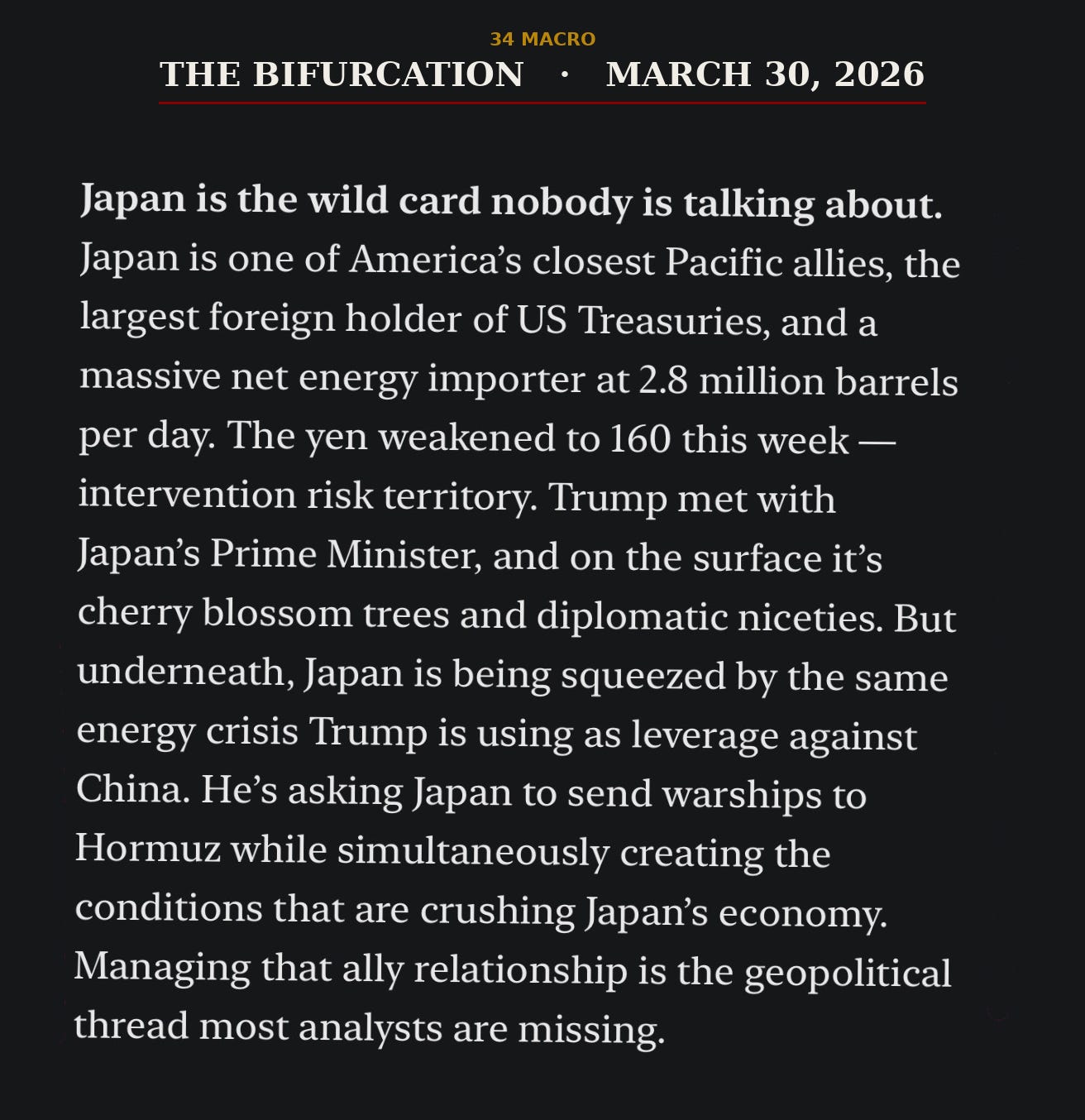
In The Bifurcation, I wrote:
Japan is the wild card nobody is talking about. Japan is one of America’s closest Pacific allies, the largest foreign holder of US Treasuries, and a massive net energy importer at 2.8 million barrels per day. The yen weakened to 160 this week — intervention risk territory. Trump met with Japan’s Prime Minister, and on the surface it’s cherry blossom trees and diplomatic niceties. But underneath, Japan is being squeezed by the same energy crisis Trump is using as leverage against China.
In March, 160 was the risk of intervention. By August, intervention has fired, the U.S. has joined it, and the Treasury has pledged whatever it takes. I did not just flag the wild card. I named the level and the tail, five months early.
Now connect the politics to the plumbing. Japan’s Prime Minister is Sanae Takaichi — the country’s first female leader, elected on a “Japan is back,” pro-alliance, military-buildup platform. She met Trump in Tokyo last October and again at the White House on March 19, and the through-line of that relationship is capital: a $550 billion Japan-U.S. strategic investment package — shipbuilding, energy, critical minerals — Japanese money committed into the American economy. Japan is the largest foreign holder of U.S. Treasuries, roughly $1.2 trillion. It runs a structural surplus that has to be invested somewhere, and for decades that somewhere has been the United States.
So the FX intervention is not charity. It is the currency expression of a capital alliance the two governments have been building in public. Washington defends the yen because a disorderly yen — a carry unwind — would force Japan to sell the very Treasuries and U.S. assets that fund the American bull. Defending the yen is defending the buyer. That is the valve.
The Valve: How the Yen Funds the American Bull
Here is the machine in one sentence: Japan exports its surplus into U.S. assets, and U.S. Treasuries are the valve that lets the American dollar stay home while Japanese liquidity flows out to the rest of the world.
Follow the flow. Japan runs a persistent trade and investment surplus — it earns more abroad than it spends. That surplus is savings that have to go somewhere. The deepest, most liquid pool on earth is the U.S. Treasury market, so a huge share of it goes there. When Japan buys Treasuries, it is lending the U.S. its savings — and in doing so it keeps U.S. borrowing costs lower than they otherwise would be, which supports U.S. equities and the whole risk complex.
Now layer in the intervention. When Japan’s Ministry of Finance intervenes to strengthen the yen, it sells U.S. dollars from its reserves and buys yen. On the surface that looks like Japan pulling money out of the U.S. But that is the official flow, and it is small and temporary next to the structural one. Underneath, the private recycling — the surplus, the coupon reinvestment, the hedged institutional buying — keeps running into U.S. assets. The valve stays open.
This is the reconciliation the skeptic misses. “Japan is intervening, so it must be selling U.S. assets and pushing our yields up.” No. The intervention strengthens the yen at the margin; the structural recycling funds the U.S. underneath. Two different flows, two different actors, two different time horizons. And critically — they hit two different parts of the U.S. yield curve. That is the deepest part of this whole thesis, and it is next.
The Belly and the Long End
This is the mechanism I want you to actually understand, because it is where the whole regime becomes legible — and it closes a loop from Playing the Field.
First, the map. The U.S. Treasury curve has three zones. The front end — bills out to about 2 years — is basically the Fed; it prices where policy is and where it is going. The long end — 20 to 30 years — is term premium, the extra yield you demand to lock your money up for decades against inflation, deficits, and the sheer supply of new bonds. The belly is everything in between, call it 3 to 10 years, centered on the 5- to 7-year. “Anchoring the belly” means buying that clusters in those middle maturities and holds their yields down even while the long end climbs.
In Playing the Field I told you the 30-year yield spiking to a 19-year high was a bear steepener for the right reason — growth and term premium, not distress. That was true. But there is a second engine underneath it, and it is Japanese. Here is the two-flow mechanism.
The money coming back into the U.S. clusters in the belly and the 10-year. Two reasons. First, the 10-year is the world’s benchmark — the deepest, most liquid point on the curve — so reserve managers and hedged institutions moving size default there. Second, the hedge math forces it. A Japanese buyer who hedges the currency pays roughly the short-rate gap — U.S. 3.5 to 3.75% versus Japan’s 1% — plus the cross-currency basis, to strip out the FX risk. That is an expensive hedge, near 3%. On the front end, the hedged yield is negative — no buyer. You have to go far enough out the curve for the yield to clear the hedge cost, and that lands you in the belly and the 10-year. But not the 30-year — out there you are taking enormous duration risk for marginal extra hedged carry, exactly when the long end is repricing, and rate-sensitive books will not hold that. So the hedged flow concentrates in the belly. That is why the 10-year sits near 4.7% while the 30-year screams toward 5.2%.
Now the other engine, and this is the elegant half: the buyer that used to hold the U.S. 30-year down has gone home. Japanese life insurers have long-dated yen liabilities — annuities, whole-life policies — so they need long-duration assets to match them. For a decade the BOJ pinned Japanese yields near zero, so they could not get that duration at home; they reached into the U.S. 30-year to get it. That was price-insensitive, buy-and-hold demand — a structural anchor sitting on the U.S. long end for years. Now the BOJ is normalizing: it has hiked to 1%, it is tapering its bond purchases, and Japanese long yields have exploded to multi-decade highs — the 10-year JGB hit 2.90% in July, its highest since 1996, and the 30-year JGB printed all-time highs near 3.9% this year. Suddenly the lifers can get all the duration they need at home, in their own currency, with no hedge cost. So they are repatriating — rotating out of the U.S. 30-year and into JGBs. Pull that structural buyer out, and the U.S. 30-year loses its anchor and reprices higher.
This is not my theory. The Financial Times’ Colby Smith has reported exactly this — that record-high JGB yields are triggering repatriation bets, and that when Japanese yields jumped earlier this year, the U.S. 30-year rose to its highest in months in lockstep. The transmission channel is real, and it is being watched by the people who move the size.
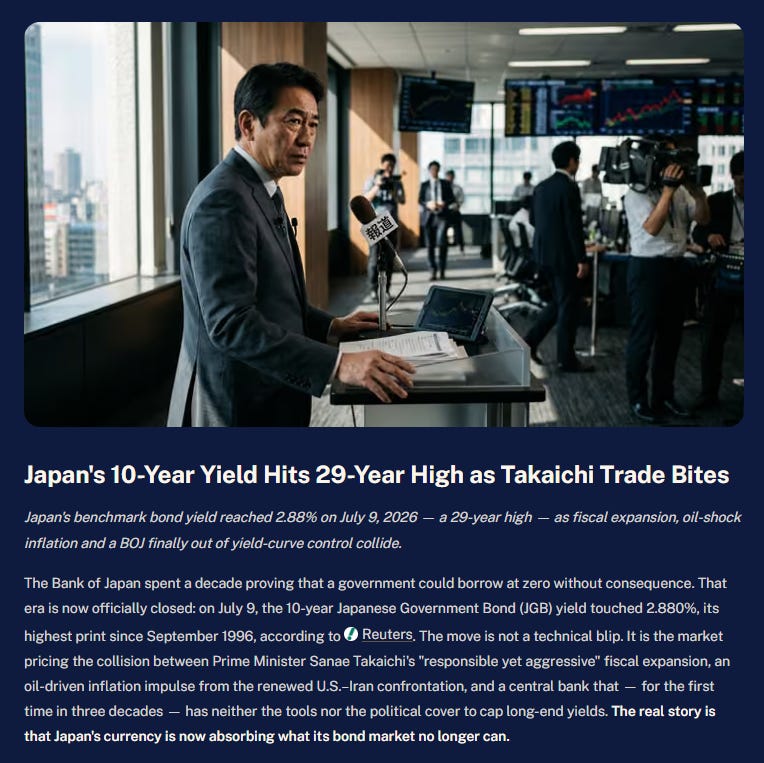
Put the two engines together and it is one story: Japan. The money coming back anchors the belly. The lifers going home un-anchor the 30-year. Same country, opposite ends of the curve — and the visible result is the exact bear steepener I called in Playing the Field, except now you can name the machine. The steepness is not distress and it is not random. It is the fingerprint of Japan normalizing its own curve and rerouting its capital across the Pacific. When I told you the steepener was “for the right reason,” this is the reason.
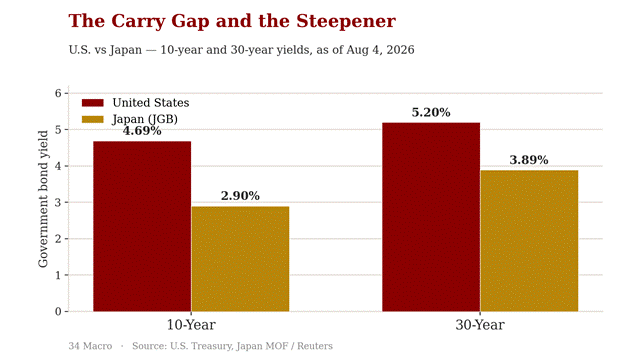
The carry gap and the steepener in one frame — the U.S. 30-year runs above the 10-year, while both tower over Japan’s even with JGB yields at multi-decade highs. That gap is what funds the carry. Levels as of Aug 4, 2026.
The Board Confirms It
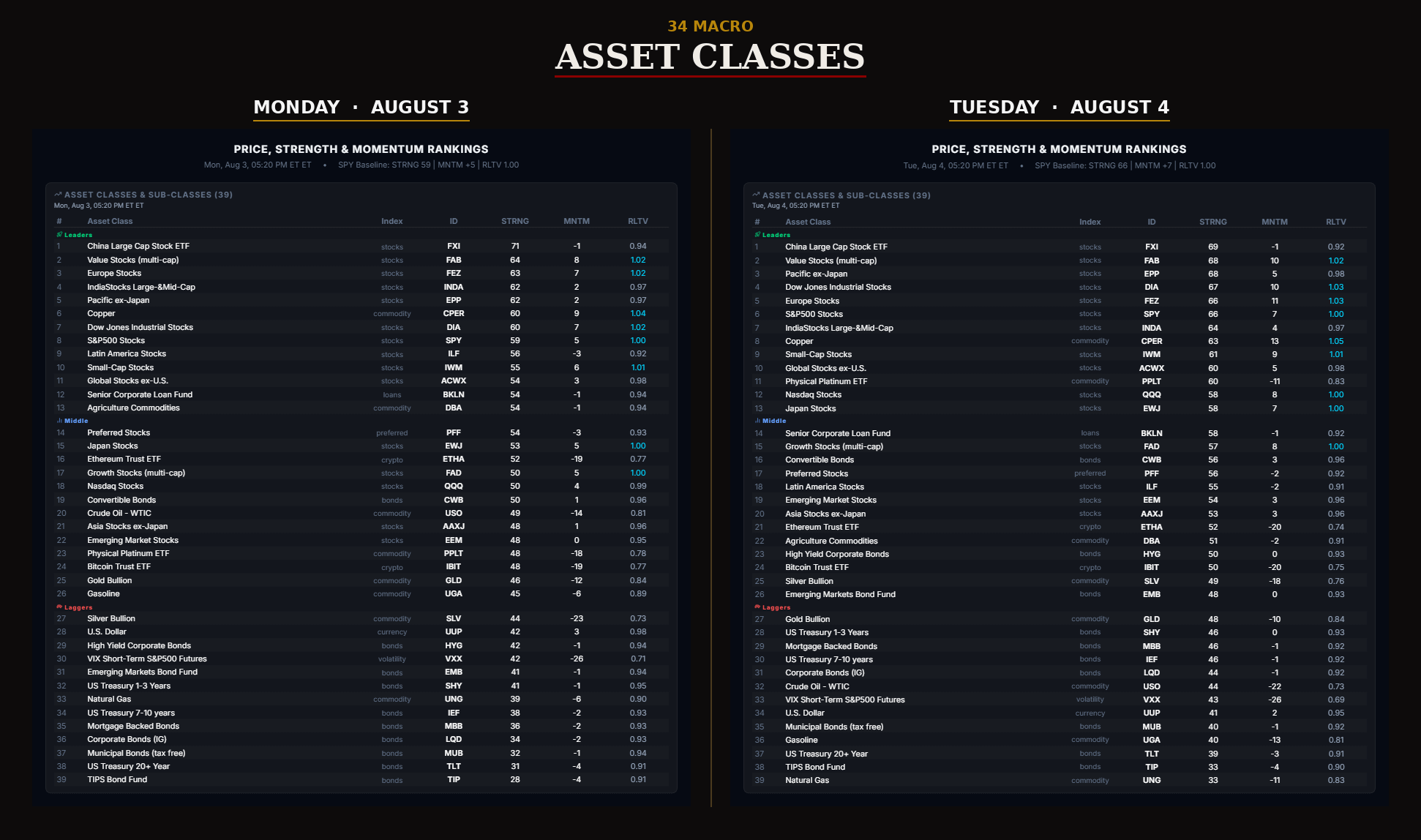
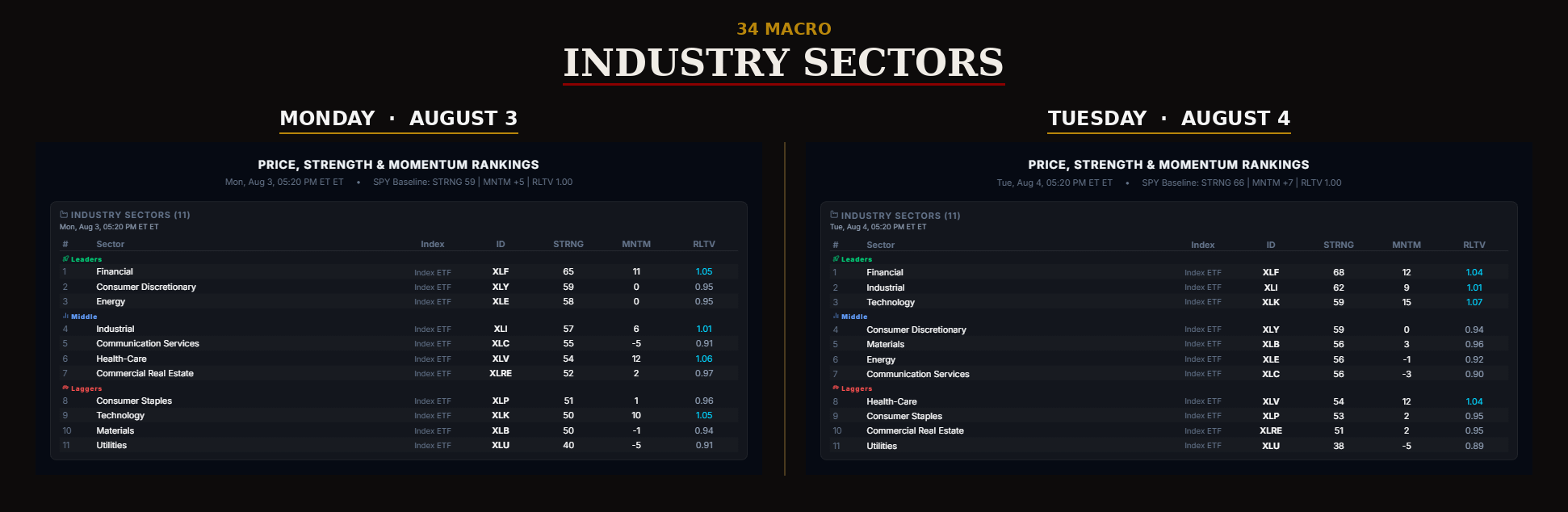
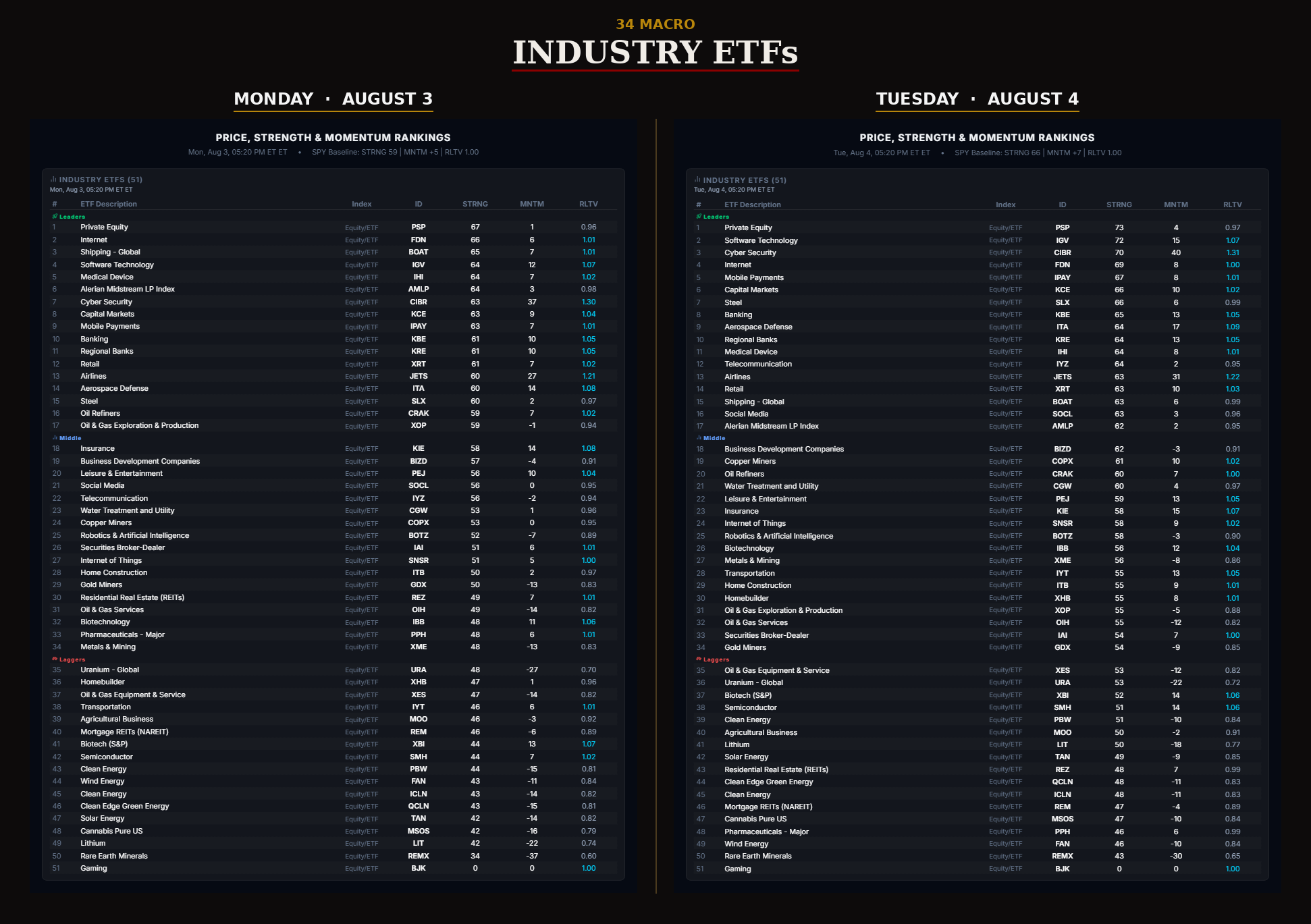
I do not want you to take the thesis on faith, so here is the institutional read next to it. Every night I run my own model. I no longer read anyone else’s institutional rankings — I built my own, the Price, Strength and Momentum dashboard, and it scores every sector, asset class, and industry group on where capital is actually flowing, not where the narrative says it should, then routes a positioning read through a fixed six-gate spine. It is the tape, ranked, through my own engine. Here is what it did across the two closes that bracket the intervention and the backstop — Monday to Tuesday.
Start with the sectors. Financials sat at number one both days and got stronger — a strength score of 65 rising to 68. That is the steepener and the recycling regime showing up exactly where it should: banks and capital markets are the direct beneficiaries when the curve steepens and money moves through the system. Underneath, the rotation broadened hard. Technology climbed from the bottom half of the board to number three; Industrials jumped from the middle to number two. That is the AI-infrastructure bull widening out of a handful of names into the whole complex — the thing I have been arguing all along. And Energy slipped from number three to number six — the tape confirming what the oil price already told you: the deal headlines cracked crude, and the rotation moved on.
Now the asset classes, where the yen thesis prints directly. The U.S. Dollar slid further into the laggards — the soft-dollar path my 60-year DXY thesis has argued since January, showing up in the rankings. Crude oil cratered, dropping from the middle of the board into the bottom ten with momentum collapsing — oil cracked, on schedule. Japanese equities climbed — a stabilizing yen supporting Japanese risk, exactly what the backstop is built to do. Copper strengthened. And U.S. Treasuries sat at the very bottom, weak across the board — which is not a contradiction, it is the bear-steepener backdrop I described: bond prices falling because yields are rising, the whole point of the piece.
Down at the industry level, the same complex lit up: Cyber Security into the top three, Software Technology to number two, Capital Markets and Banks and Regional Banks climbing, Aerospace Defense strengthening, Steel and Copper Miners jumping. Every leg of the regime I have been tracking — AI-infrastructure, financials, industrials, defense, copper — is in the leaders. None of this is the board leading me. It is the board confirming what the framework already called.
The macro told you before the news. The board is just the receipt.
The Two Ways This Breaks
I am not going to sell you the clean version and hide the risk. The framework is built on being honest about what would invalidate it. So here is the strongest argument against me, and the test that settles it.
The bear case is simple and it has history on its side: intervention against fundamentals does not work. When a currency is weak because of an overshoot — because the market got ahead of itself — intervention can snap it back. But when a currency is weak because of fundamentals, like a wide interest-rate gap, intervention is just lighting money on fire. Japan tried it solo in 2022 and again in 2024, spending tens of billions each time, and the yen kept sliding because the rate differential was the real driver. A skeptic looks at this week and says: same movie, same ending. The backstop is theater.
Here is why this time is different, and it is the whole thesis. This is not solo-Ministry-of-Finance-versus-fundamentals. It is three things at once. One, the BOJ is actually hiking — closing the rate gap that beat the 2022 and 2024 interventions, so the fundamental driving yen weakness is finally reversing. Two, the U.S. backstop is credible and open-ended — the Draghi mechanism, which works on credibility, not just on spent reserves. Three, the structural recycling is still running underneath. Solo intervention against a widening gap failed. Coordinated intervention into a narrowing gap, with a superpower’s balance sheet behind it, is a different trade.
Now the tell — how you will know, in real time, which way it is going. If the valve is holding: the yen firms, the belly stays bid, the 30-year runs on term premium, the dollar stays soft. That is the managed version, and the bull holds. If the valve is flipping to an accelerant: the yen spikes violently, and the belly sells off with the long end — the whole curve blows out in parallel — because Japanese money is being pulled out of U.S. assets to repatriate and de-lever, not recycled in. Watch the belly. As long as the 10-year holds while the yen firms, recycling is winning. The day the 10-year blows out alongside a spiking yen, the carry is unwinding for real, and the AI-infrastructure longs — mine included — are in the blast radius. That is the line I am watching. That is the line you should watch.
The Loop Closes: Two Central Banks, One Tape
Step back and look at what just resolved.
In March I wrote that Japan was the wild card nobody was watching. In Playing the Field I resolved the Fed — Warsh as the strategic dove the market had backwards. This piece resolves Japan. And read together, the two central banks are not fighting. They are pointing the same way.
Warsh holds and lets reported inflation cool, keeping U.S. real rates from spiking. The BOJ hikes and defends the yen, capping the carry unwind. The U.S. Treasury backstops Tokyo with whatever it takes. Japanese capital keeps recycling into the belly. The dollar softens — exactly the path my 60-year DXY thesis has argued for since January. Liquidity exports. The bull is funded. Every thread I have been tracking since March — the Fed hold, the bifurcation, Trump’s narrative control, gold on its debasement axis, and Japan the wild card — lands on the same tape.
I said it in March. August proved it. I do not need to add anything to that.
The Ledger
The framework is not a paper exercise. It runs the Black Star family accounts — my parents’ retirement, my kids’ futures — and I show the real numbers, up periods and down.

From the March 30 baseline — the depth of the drawdown, when I went quiet and rebuilt the system instead of forcing trades — the total family book is up more than $25,000. The All-Weather portfolio carried it, up over $13,000 as the regime it was positioned for came back around. The options book is roughly flat across the stretch. Never the biggest number in a melt-up — a macro book is not built for that — but capital intact, compounding, and positioned for exactly the regime now unfolding.
I am positioned for the managed version of this regime: a soft dollar, a funded bull, the belly anchored, and the AI-infrastructure and industrial complex — the exact leaders the board just confirmed — intact. The trip wire is the belly-and-yen tell. If the 10-year blows out alongside a spiking yen, the trade is wrong and the book de-risks. Until then, the tape says stay with it.
The Path Forward
Here is what I am watching into the back half of August, in causal order.
The yen and the belly, together — the core tell. As long as the yen firms and the 10-year holds near 4.7%, the valve is open and recycling is winning. Watch for the two to diverge.
The BOJ path — Japan’s July inflation on August 21, then the September meeting. A hike to 1.25% closes the rate gap further and validates the managed-unwind read. A dovish surprise re-opens the carry and the yen weakens again.
Jackson Hole — the other half of the trade from Playing the Field. If Warsh cracks the door toward patience while the BOJ tightens, the two-central-bank convergence is complete.
And the level. The yen was pushed off 164 back to about 157 this week. If it holds the intervention and grinds stronger while the BOJ hikes, the backstop is working and the tail is capped. If it slides back toward 160 and beyond, the market is telling you the fundamentals are still winning and the risk is live again.
I am positioned for the managed version — soft dollar, funded bull, belly anchored, the AI-infrastructure and industrial complex intact — with the belly-and-yen tell as the trip wire that would tell me I am wrong. That is the trade. The tape will tell us which way it breaks.
Process Over Prediction
I did not predict the intervention. I flagged the level and the tail in March, built the framework, and waited for the tape to confirm or invalidate it. This week it confirmed — Japan hiking, the yen at a 40-year low, the U.S. Treasury crossing the Pacific with whatever it takes. The wild card I named five months ago is the story now.
None of that was a forecast. It was a process. Observe, hypothesize, test, refine.
Process over prediction. Data over headlines. Framework over fear.
Pressure, not panic. Regime, not reaction.
The goal is not for you to depend on me. The goal is for you to not need me.
Glossary
Carry trade. Borrowing money in a cheap, low-rate currency — for two decades, the Japanese yen — and using it to buy higher-yielding assets elsewhere. Cheap and stable funding levers up global risk; a rising funding cost or a strengthening funding currency forces the trade to unwind.
Funding currency. The currency the world borrows to fund other bets. The yen has been the primary one because the Bank of Japan held rates near zero for a decade. When it stops being cheap, the leverage it supports has to come down.
The belly (of the yield curve). The intermediate maturities — roughly 3 to 10 years — between the front end (set by the Fed) and the long end (set by term premium). Buying concentrated here can hold these yields down independently of the 30-year.
Currency-hedged buying. A foreign investor buying U.S. bonds while using FX forwards to cancel the currency risk. The hedge costs roughly the short-rate difference between the two countries, which is why, when U.S. rates sit far above Japan’s, the hedge is expensive and pushes buyers toward the belly rather than the front end.
Lifer repatriation. Japanese life insurers — which need long-dated assets to match long-dated liabilities — rotating out of U.S. long bonds and back into Japanese government bonds as domestic yields rise. It removes a structural buyer from the U.S. 30-year.
Coordinated intervention. Two or more governments jointly buying or selling a currency in the market to move it. To strengthen the yen, authorities sell dollars and buy yen. A “rate check” — officials calling dealers for live prices — is often the signal it is imminent.
Term premium. The extra yield investors demand to hold a long-dated bond rather than rolling short ones. It rises with uncertainty, inflation risk, and bond supply, pushing the long end up on its own.
Price, Strength and Momentum (PSM) model. My in-house ranking engine — built on my own dashboard, not an outside vendor. It scores every asset class, sector, and industry on price, strength, and momentum, and routes a positioning read through six gates: the clock, the fear variable, the phase, leadership, the wire and the bar, and the routed decision.
— 34 Macro
Pressure, not panic. Regime, not reaction.
Cross-asset macro research and education — built for the everyday person.
The information on this website/Substack is for information purposes only. It is believed to be reliable, but 34 Macro does not warrant its completeness or accuracy. The information on the website/Substack is not intended as an offer or solicitation for the purchase of stock or any financial instrument. The information and materials contained in these pages and the terms, conditions and descriptions that appear, are subject to change without notice. Unauthorized use of 34 Macro websites and systems including but not limited to data scraping, unauthorized entry into 34 Macro systems, misuse of passwords, or misuse of any information posted on a site is strictly prohibited. Your eligibility for particular services is subject to final determination by 34 Macro and/or its affiliates. Investment services are not bank deposits or insured by the FDIC or other entity and are subject to investment risks, including possible loss of principal amount invested. Your use of any information which is proprietary to 34 Macro or a third-party information provider shall only be used on individual devices without any right to redistribute, upload, export, copy, or otherwise transfer the information to any centralized interdepartmental or shared device, directory, database or other repository nor to otherwise make it available to any other entity/person/third party, without the prior written consent of 34 Macro.